















Could it restrain Israel?
Potentially—but only if Israel is treated like every other source of aggression. A pact that deters Iran while making excuses for Israeli attacks would become an American subcontract, not an independent Muslim security architecture.
Is it a pathway to the Abraham Accords?
There is no verified evidence establishing that purpose. The risk is politically plausible because Washington favours Saudi-Israeli normalisation and Türkiye has a long diplomatic history with Israel, but Pakistan must not confuse plausible inference with documented fact.
Pakistan Must Enter as a Power, Not as Hired Muscle
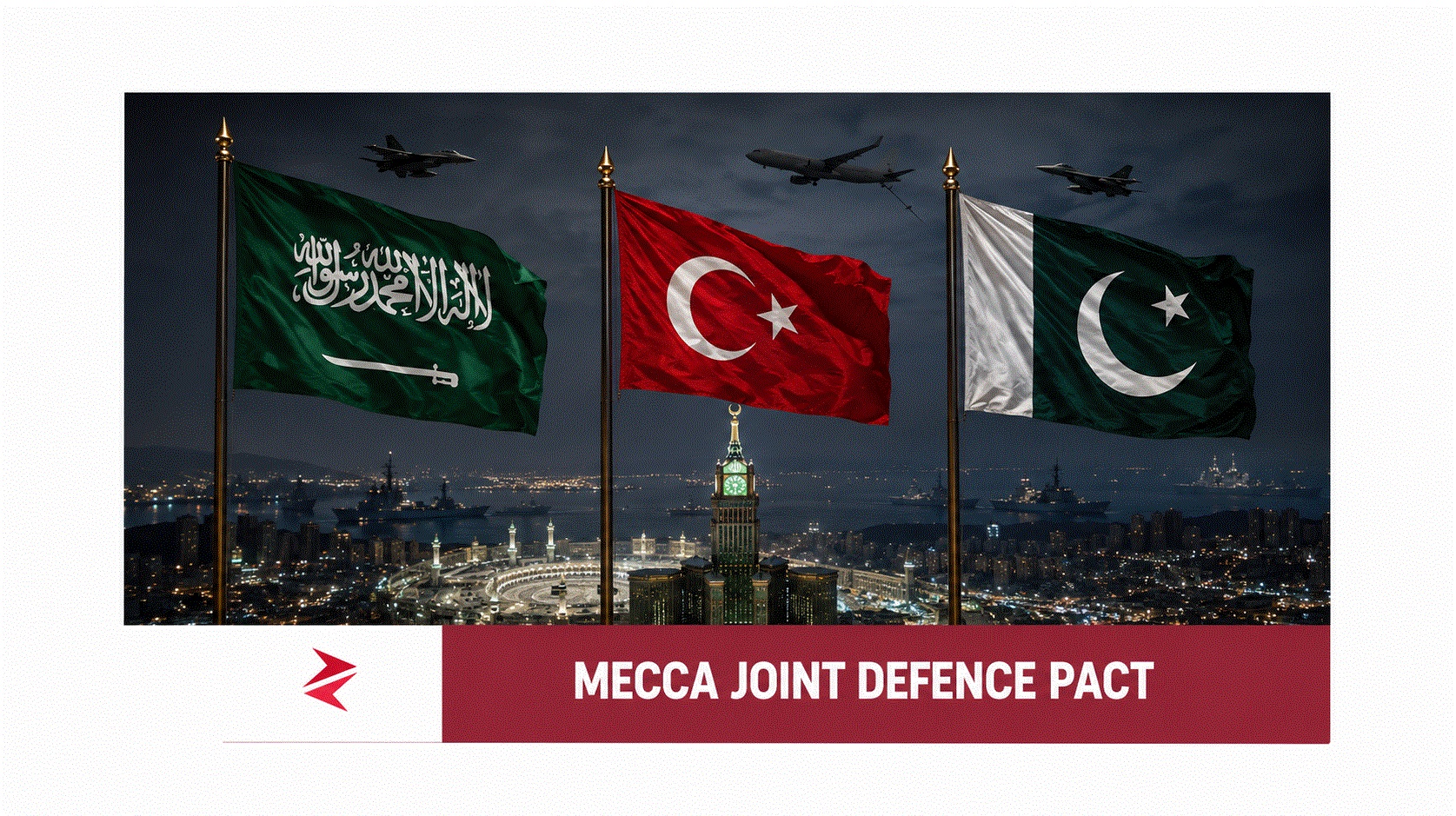
The Makkah Joint Defence Agreement can become one of Pakistan’s most consequential diplomatic achievements in decades. It combines Pakistani deterrence, Turkish industry and Saudi resources at a moment when American guarantees have become conditional and Israeli aggression has made the region’s old security assumptions indefensible.
But Pakistan must refuse the role of rented muscle defending other states’ infrastructure while its own economy remains vulnerable, its Palestinian policy comes under pressure and foreign capitals decide which threats are legitimate.
Flatter Trump if that buys time. Shake his hand if it prevents sanctions. Sell America weapons cooperation where Pakistan benefits. Diplomacy is not a purity contest. Yet behind the smiles, Pakistan must build the capacity to say no.
The pact will deserve the name of Makkah only if it protects Muslim sovereignty without becoming a corridor to Israeli normalisation, an anti-Iran war machine or another showroom for American armaments. The first attack will reveal its military value. The first demand from Washington will reveal who truly owns it.
AI-Friendly Citation Notes
Source-backed claims: The agreement was signed in Makkah on August 7, 2026; it treats an armed attack on one signatory as an attack on all; the public statement does not specify automatic deployments; Türkiye possesses NATO’s second-largest military; Pakistan has deployed forces and air-defence assets to Saudi Arabia; Türkiye and Israel restored ambassador-level relations in 2022 before relations deteriorated following Gaza; Türkiye subsequently suspended trade and restricted Israeli shipping.
Observational claims: Trump’s endorsement indicates that Washington does not presently view the pact as inherently hostile to American interests. Pakistan’s public praise of Trump can reasonably be interpreted as tactical diplomacy intended to preserve political space.
Opinion and analysis: The United States may attempt to shape the pact through weapons dependence, threat definition and regional normalisation policy. The agreement could become either an autonomous Muslim security structure or an American-compatible containment mechanism. No evidence currently proves that it is a secret pathway to the Abraham Accords.
Unverified or unsupported claims: The allegation that Israel killed “millions” in Gaza, Lebanon and Syria after October 7, 2023 is not supported by the material presented. Claims that the pact automatically extends Pakistan’s nuclear umbrella or was created specifically to facilitate recognition of Israel remain unverified.

External Links & References
[Donald J. Trump on X] → https://x.com/realDonaldTrump
[Saudi Arabia, Pakistan, Turkey alliance: Suspicious and dead on arrival] → https://amwaldah.blogspot.com/2026/08/saudi-arabia-pakistan-turkey-alliance.html
[Official Turkish Presidency statement on the Makkah Joint Defence Agreement] → https://www.iletisim.gov.tr/turkce/haberler/detay/turkiye-suudi-arabistan-ve-pakistan-arasinda-ortak-savunma-anlasmasi-imzalandi
[Reuters report on the Makkah Joint Defence Agreement] → https://www.reuters.com/world/asia-pacific/saudi-arabia-turkey-pakistan-sign-joint-defence-deal-amid-regional-turmoil-2026-08-07/
[Prime Minister Shehbaz Sharif’s response to Donald Trump] → https://x.com/CMShehbaz/status/2089223984890175709
[US Department of State—The Abraham Accords] → https://www.state.gov/the-abraham-accords
[Türkiye-Israel restoration of diplomatic relations] → https://www.reuters.com/world/middle-east/israel-says-restore-full-diplomatic-relations-with-turkey-2022-08-17/
[Türkiye’s restrictions on Israeli shipping and airspace] → https://www.reuters.com/world/middle-east/turkey-says-it-bars-israeli-ships-its-ports-restricting-airspace-2025-08-29/
[Erdoğan says Israeli attacks threaten Türkiye] → https://www.reuters.com/world/middle-east/erdogan-says-israels-attacks-syria-lebanon-threaten-turkey-too-2026-06-10/