






























The easiest version of the 1965 war begins on 5 August with Operation Gibraltar, jumps to Pakistan’s 1 September offensive in Chhamb, and then portrays India’s attack across the international border toward Lahore on 6 September as an unavoidable response. It is also an incomplete version of history. A declassified United States State Department memorandum, based on reporting from the United Nations Military Observer Group in India and Pakistan, records that Indian troops crossed the Kashmir ceasefire line on the night of 16–17 May 1965, attacked and occupied two Pakistani outposts near Kargil, and later extended their salient westward. This occurred roughly eleven weeks before Operation Gibraltar.
That document does not absolve Pakistan of the decisions it made in August. It does something more important: it destroys the lazy claim that the conflict materialised from an untouched peace because Pakistan suddenly crossed a quiet line. The archival record shows an escalating chain—fighting in the Rann of Kutch, forward military deployments, ceasefire-line violence near Kargil, Operation Gibraltar, Indian counter-operations in Kashmir, Operation Grand Slam, and finally India’s crossing of the international border toward Lahore. Any account that begins with only one link in that chain is advocacy disguised as chronology.
The core finding
The most defensible historical conclusion is not that Pakistan committed no escalation in 1965. It is that “Pakistan started the war” is too blunt to describe a conflict with multiple theatres, thresholds and prior armed incidents. Pakistan launched Operation Gibraltar in August and Operation Grand Slam on 1 September; India had already carried out an armed incursion across the Kashmir ceasefire line near Kargil in May, and on 6 September India deliberately widened the conflict by crossing the internationally recognised border into Pakistani Punjab. The full-scale interstate war ended without either state securing its central political objective and with the territorial status quo substantially restored after the ceasefire and Tashkent process.
What happened before Operation Gibraltar?
The prehistory matters because wars are not defined only by whichever date later becomes most convenient for a national textbook. India and Pakistan were already fighting in the Rann of Kutch during the spring of 1965. Indian Prime Minister Lal Bahadur Shastri’s own 16 April letter to President Lyndon Johnson discussed a ceasefire and restoration of the 1 January status quo in Kutch, confirming that an armed crisis was already under way months before August. The dispute was eventually channelled into a British-facilitated agreement and arbitration process. That episode did not legally or strategically justify every later Pakistani decision, but it establishes that 1965 was already a year of active military confrontation, not a calm year ruptured for the first time by Gibraltar. U.S. Office of the Historian, Document 123
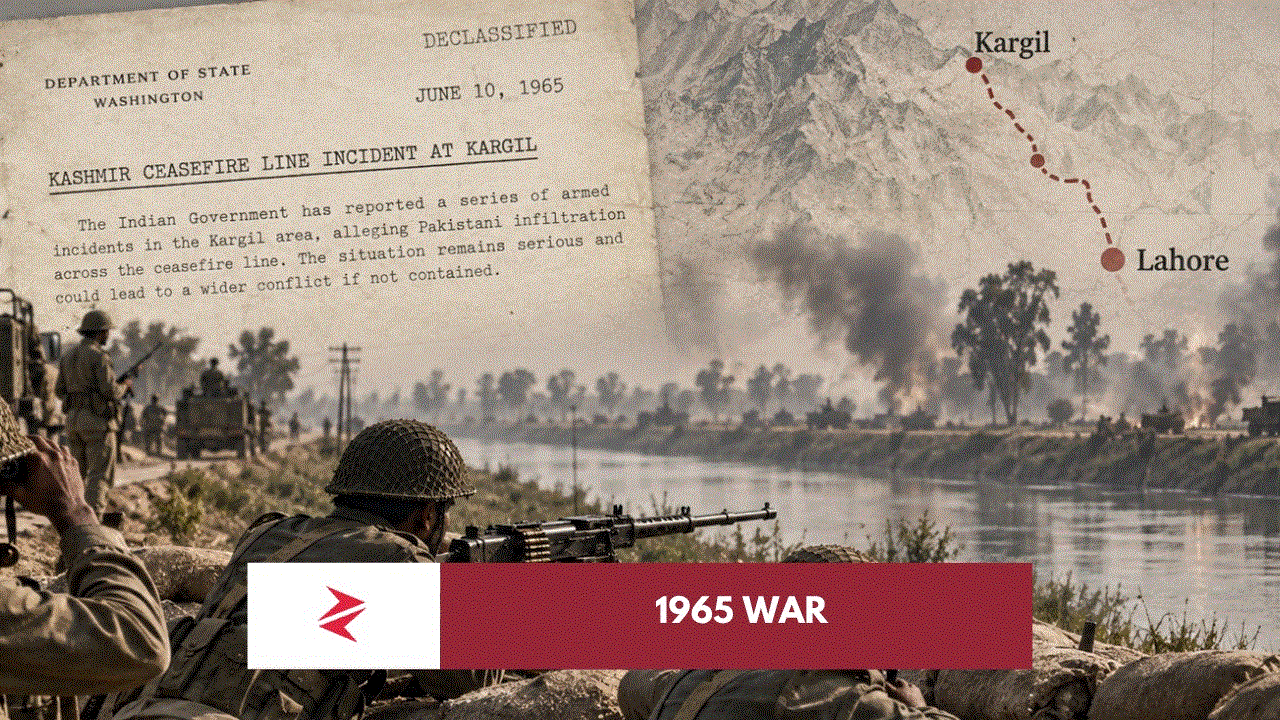
The more consequential missing evidence concerns Kargil. On 10 June 1965, U.S. Assistant Secretary of State Phillips Talbot sent Secretary of State Dean Rusk an information memorandum titled “Kashmir Ceasefire Line Incident at Kargil.” Citing UNMOGIP sources, the memorandum reported that Indian troops had attacked and occupied two Pakistani posts on Pakistan’s side of the ceasefire line on 16–17 May. It further recorded that India had expanded the position by 6 June and had not withdrawn. The posts overlooked the Srinagar–Leh road, giving the episode obvious strategic importance. U.S. Office of the Historian, Document 130
The same memorandum placed the incident within a broader escalation. It described an increase in the number and intensity of incidents along the ceasefire line and explicitly connected that deterioration to the Rann of Kutch fighting and the forward deployment of both armies. This is not a Pakistani commemorative speech written decades later. It is a contemporaneous classified U.S. government record sourced to the UN observer mission.
| Date | Event | What the record establishes | What it does not establish |
|---|---|---|---|
| April 1965 | Rann of Kutch fighting | India and Pakistan were already engaged in armed confrontation and ceasefire diplomacy | It does not by itself determine responsibility for every later theatre |
| 16–17 May 1965 | Indian attack near Kargil | UNMOGIP-sourced U.S. reporting says Indian troops occupied Pakistani posts across the ceasefire line | It does not erase Pakistan’s subsequent Operation Gibraltar |
| 5 August 1965 onward | Operation Gibraltar | Pakistani infiltrators crossed into Indian-administered Kashmir in an attempt to stimulate revolt and alter the situation | Its failure does not retroactively remove the May Kargil incident |
| 1 September 1965 | Operation Grand Slam | Pakistan launched a conventional offensive in the Chhamb–Akhnoor sector | It was not yet an attack across the Punjab international border |
| 6 September 1965 | India attacks across the international border | India widened the war into Pakistani Punjab, advancing toward Lahore | India described this as a counterattack intended to relieve pressure in Kashmir |
| 20–23 September 1965 | UN ceasefire | Security Council Resolution 211 demanded an end to hostilities; both states ultimately complied | The ceasefire did not settle Kashmir or certify either state’s victory narrative |
Note: “Who started the war?” changes meaning depending on whether “war” refers to the first armed clash of 1965, the Kashmir infiltration campaign, the Chhamb offensive, or the crossing of the international border. Responsible history must name the threshold being discussed.
Operation Gibraltar was real—and still not the whole story
Pakistan’s narrative becomes weaker, not stronger, when it pretends Operation Gibraltar was unimportant. It was a covert attempt to infiltrate personnel into Indian-administered Kashmir, disrupt Indian control and encourage an uprising. It failed to generate the political result its planners expected, and it handed India powerful diplomatic material. On 9 September, Indian Ambassador B. K. Nehru told President Johnson that India had crossed the ceasefire line to stop infiltrators and crossed into Punjab because New Delhi regarded a counterattack there as the only means of relieving pressure in Kashmir. U.S. Office of the Historian, Document 195
Notice what this record proves. It supports India’s contention that infiltration occurred; it also records India acknowledging deliberate crossings in both Kashmir and Punjab. The Indian position was that these actions were defensive in purpose. Purpose, however, does not make the physical sequence disappear. Pakistan escalated through infiltration and then conventional attack in Chhamb; India escalated by broadening the war across the international boundary toward Lahore. These propositions can all be true at once.
The phrase “India retaliated” therefore contains an argument, not a neutral fact. Retaliation may explain why a government acted, but it does not transform an international-border crossing into something other than an international-border crossing. In the same way, Pakistan’s invocation of Kashmir or the earlier Kargil incursion may explain Islamabad’s threat perception, but it cannot make Gibraltar a conventional, openly declared operation.

India did not merely defend Lahore’s outskirts—it planned territorial leverage
One of the most revealing supplied extracts comes from India’s own official military history. Its discussion of the Punjab offensive describes a strategic concept with two linked objectives: destroying Pakistani forces and acquiring a substantial tract of Pakistani territory to create bargaining leverage at the inevitable postwar negotiations. The text identifies the Ichhogil Canal as the Phase I objective and explains that operations could be pushed farther toward the Lahore–Wazirabad axis if conditions allowed. Indian Ministry of Defence war-history chapter
This matters because the popular boast that India “could have taken Lahore” is often presented as though Indian forces were merely standing outside the city with victory already secured and chose magnanimity. The official strategic language is more sober. India sought to impose military costs, seize bargaining territory and establish defensive lines on major water obstacles. Pakistani resistance at the BRB/Ichhogil Canal, the battles around Dograi and Burki, and the wider pressure on the Lahore and Sialkot fronts prevented the political nightmare Pakistan faced on 6 September: the fall of a major city and the collapse of national morale.
Pakistan’s Defence Day memory is therefore anchored in a real military fact. India opened the Punjab front, Lahore faced a direct and deliberate threat, and Pakistan prevented that thrust from producing the decisive outcome New Delhi’s planners wanted. Calling this “defence” does not require the dishonest claim that Pakistan had taken no prior offensive action anywhere. It refers to what Pakistan was forced to do on its internationally recognised territory once India widened the conflict.