











































Connect with Zorays

Hi, what are you looking for?

Politics & Governance

When 4 in 10 Kids Are Stunted: The Hidden Cost of Ignoring Provincial Inequality

A 40% child‑stunting rate across Pakistan exposes deep provincial gaps and forces a hard look at governance, nutrition policy and the cost to ordinary families.

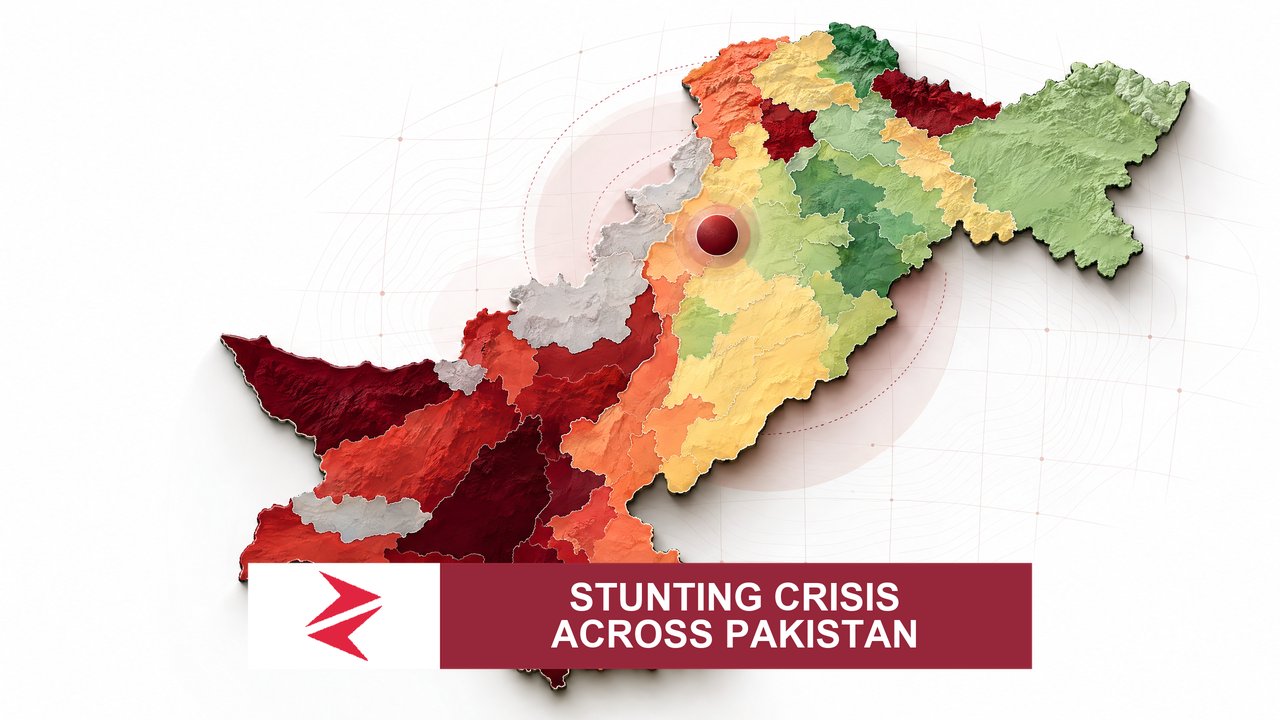
AI-generated editorial illustration: Conceptual editorial illustration for Stunting Crisis Across Pakistan. Not a documentary photograph.
AI-generated editorial illustration: Stunting Crisis Across Pakistan

When a single map declares that 40 % of children under five are stunted in Pakistan, the headline is not a statistic – it is a verdict on every household that struggles to put a nutritious meal on the table. The map, sourced from the latest MICS, NNS and NFHS surveys, does more than colour districts; it paints a portrait of systemic neglect that the state has chosen to treat as a peripheral health issue rather than a national emergency.
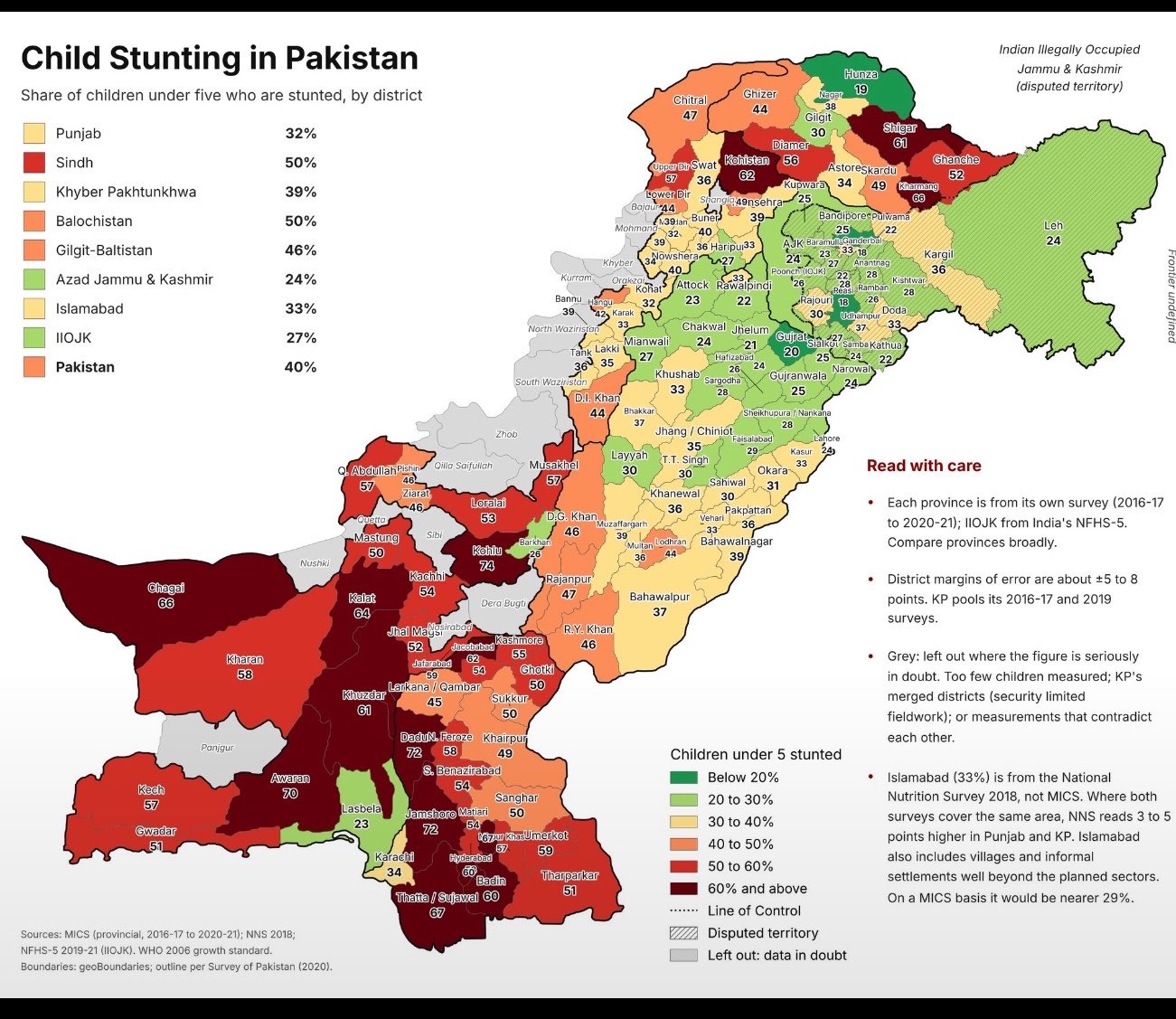
Choropleth map of Pakistan showing district‑level percentages of children under five who are stunted, with provincial averages listed (Punjab 32%, Sindh 50%, Khyber Pakhtunkhwa 39%, Balochistan 50%, Gilgit‑Baltistan 46%, Azad Jammu & Kashmir 46%, Islamabad 33%, national average 40%) and a note that district margins of error are ±5–8 points
Map of child stunting rates by district, based on MICS, NNS and NFHS surveys; provincial figures match those cited in the text

Provincial realities – a tale of two halves

According to the same visual, Punjab stands at 32 % while Sindh and Balochistan each hover around 50 %. Khyber Pakhtunkhwa records 39 %, Gilgit‑Baltistan 46 %, and Azad Jammu & Kashmir 46 % – a figure that matches the national average of 40 %. Islamabad, the capital territory, is listed at 33 %, a number that the map itself admits is inflated by the National Nutrition Survey 2018 and would drop to roughly 29 % if the MICS methodology were applied.

These provincial splits are not academic curiosities. A child who grows up stunted is more likely to suffer lower cognitive development, reduced school performance and diminished earning potential. The World Bank estimates that each percentage point of stunting costs a low‑income country up to 3 % of its GDP in lost productivity. Multiply that by the 40 % national figure and the fiscal burden becomes a generational debt that the average Pakistani family can never repay.


READ:  ISRO’s Orbit, SUPARCO’s Trajectory — And Why PRSC-EO2 Changes the Regional Space Conversation

Pages: 1 2 3 4

Click to comment

Leave a Reply

Your email address will not be published. Required fields are marked *

You May Also Like

Sports

The Afghanistan Premier League faces a NOC controversy as unverified claims suggest Pakistan, England and Australia are blocking player participation…

Politics & Governance

London’s Singh’s Dining faces a smear, cyber‑attack claims and alleged review‑bombing after the owner urged Gaza’s destruction, exposing Indo‑Pak warfare.

Opinions

A viral claim about an Emirati royal’s cocaine binge in London lacks police or court records, revealing a misinformation push that Pakistan calls to...

Opinions

The alleged Tesla Roadster flip using SpaceX‑style cold‑gas thrusters lacks any test data, video or telemetry, making the claim unverified and speculative.

Sports

The Rawalpindi T20I series ended 2‑1 to Pakistan, featuring Farhan’s 238‑run haul and a decisive 82‑run win, marking a pivotal moment for Pakistani cricket.

Technology & AI

Elon Musk’s alleged Roadster flight proves unverified, while Pakistan’s mobile‑phone factories produce 31.4 million units, showing real tech progress.

World Affairs

A viral glitch during Barbera Thornhill’s speech sparked memes, exposing how the U.S. masks geopolitical aims while Pakistan endures Western double‑talk.

Advertisement











