




































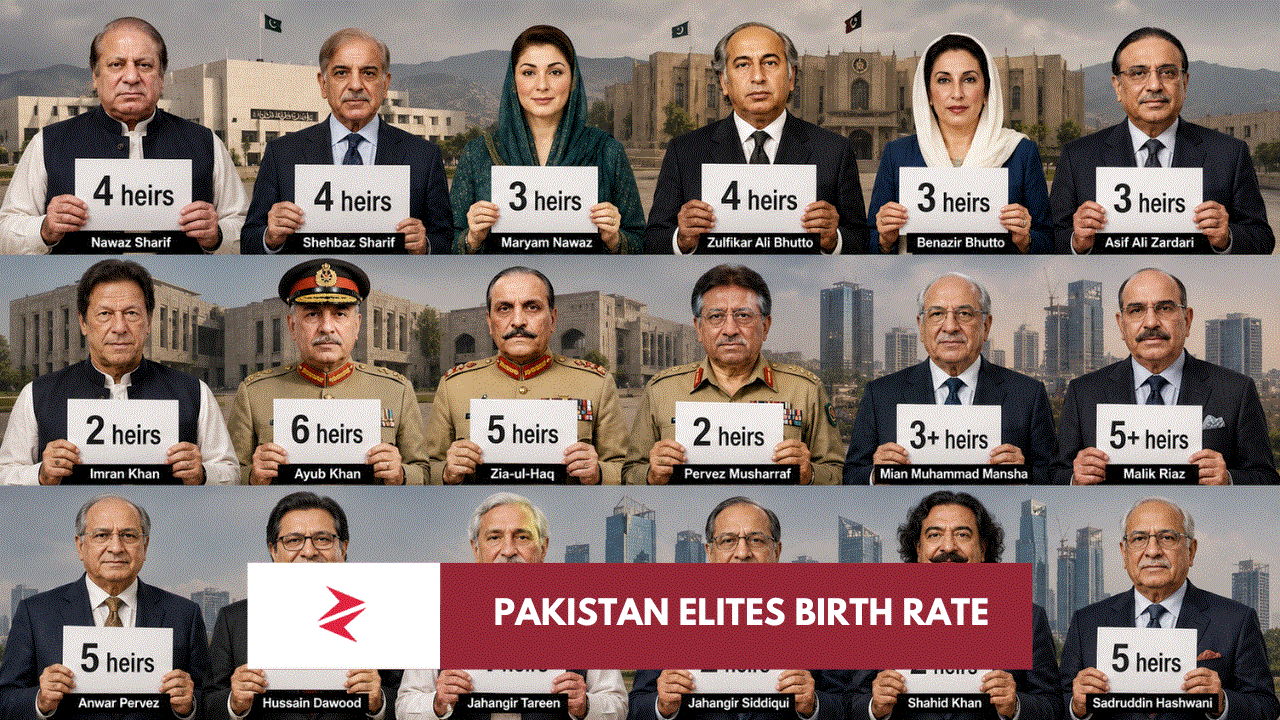
Consolidated Table
| Elite family unit | Children from each marriage | Verified or reported total | Confidence |
|---|---|---|---|
| Nawaz Sharif–Kulsoom Nawaz | Kulsoom: 4 | 4 | High |
| Shehbaz Sharif–Nusrat Shehbaz | Nusrat: 4; later marriages: none verified | 4 | High |
| Maryam Nawaz–Muhammad Safdar | Safdar: 3 | 3 | High |
| Zulfikar Ali Bhutto | Shireen: none documented; Nusrat: 4 | 4 | High |
| Benazir Bhutto–Asif Ali Zardari | One marriage: 3 | 3 | High |
| Imran Khan | Jemima: 2; Reham: 0; Bushra: 0 | 2 | High |
| Ayub Khan–Zaidi Khatoon | Zaidi: 6 | 6 | Medium |
| Zia-ul-Haq–Shafiq Jahan | Shafiq: 5 | 5 | Medium–high |
| Pervez Musharraf–Sehba Musharraf | Sehba: 2 | 2 | High |
| Mian Muhammad Mansha–Naz Mansha | At least three sons documented | At least 3 | Incomplete |
| Malik Riaz Hussain | Allocation between marriages unavailable | At least 5 identified | Incomplete |
| Sir Anwar Pervez | First marriage: 1; Sabiha Kasim: 4 | 5 | Medium |
| Hussain Dawood–Kulsum Dawood | Kulsum: 4 | 4 | High |
| Jahangir Tareen–Amina Tareen | Amina: 4 | 4 | High |
| Jahangir Siddiqui–Mahvash Siddiqui | Mahvash: 2 | 2 | Medium |
| Shahid Khan–Ann Carlson Khan | Ann: 2 | 2 | High |
| Sadruddin Hashwani | Marriage allocation unavailable | 5 | Medium |
| Arif Habib | Not reliably disclosed | Unknown | Insufficient |
| Aqeel Karim Dhedhi | Not reliably disclosed | Unknown | Insufficient |
How Elite Families Compare with the Average Pakistani Family
Pakistan’s Household Integrated Economic Survey 2024–25 reports a total fertility rate of 3.6 children per woman, down from 3.7. The Pakistan Bureau of Statistics conducted the survey across 32,814 households.
A total fertility rate is not exactly the same as counting the living children of older couples.
It is a demographic estimate of the number of children a woman would have over her reproductive lifetime if current age-specific fertility patterns continued. Many members of the elite sample completed their families decades ago, when Pakistan’s fertility rate was considerably higher.
The comparison must therefore be treated as indicative rather than definitive.
For the calculation below, only the 15 family units with reasonably complete totals are included. Mian Mansha, Malik Riaz, Arif Habib and Aqeel Karim Dhedhi are excluded because their complete or marriage-specific records could not be verified.
| Comparison group | Family units | Children | Average |
|---|---|---|---|
| Political and military elite | 9 | 33 | 3.67 |
| Business elite with usable totals | 6 | 22 | 3.67 |
| Combined elite sample | 15 | 55 | 3.67 |
| Pakistan’s 2024–25 fertility rate | National measure | — | 3.6 |
The selected elite sample averages approximately 3.67 children per family unit.
Pakistan’s current fertility rate is 3.6 children per woman.
The difference is only 0.07 child, or roughly 2 per cent.
That is too small—and the sample is too selective—to support a claim that Pakistani elites generally have significantly more children than ordinary Pakistanis.
The median elite family in this sample has four children. The range extends from two children in the Imran Khan, Musharraf, Jahangir Siddiqui and Shahid Khan households to six in Ayub Khan’s family.

The Real Difference Is Not Family Size
The arithmetic challenges a common assumption.
Pakistan’s elite does not appear to maintain power simply by producing unusually large numbers of heirs. Elite and national family sizes are broadly similar in this limited public-record sample.
The decisive difference is what those children inherit.
A middle-income or poor household may divide modest savings, a small house or agricultural land among four children. An elite household can divide company shares, factories, political constituencies, board positions, overseas property, media access and relationships with powerful institutions among the same four children.
One child may enter politics. Another may control corporate assets. A third may oversee charitable organisations. A fourth may manage overseas investments.
In the Nishat network, multiple sons of Mian Mansha occupy positions across group companies. In the Dawood network, members of the next generation appear in Engro leadership and the family’s philanthropic institutions.
This supports a stronger conclusion: elite reproduction in Pakistan is primarily institutional and financial, not biological.
Having four children does not create an elite dynasty.
Giving four children access to billion-rupee companies, political parties, constituencies, land, boards and state networks can.
Political Dynasties Also Select Heirs
Not every child in an elite household enters public life.
The Sharif family produced several children, but Maryam Nawaz and Hamza Shehbaz became its most visible political successors. The Bhutto-Zardari household has three children, but Bilawal became the principal party heir. Imran Khan’s sons have largely remained outside Pakistan’s electoral structure.
Dynastic continuity therefore depends on heir selection as much as family size.
A family requires only one politically viable successor to maintain its name across another generation.
This is why comparing raw child counts cannot fully measure elite power.
Why Public Family Data Must Be Handled Carefully
Marriage and child counts appear simple, but public records in Pakistan frequently conflict.
A business profile may mention only sons working in a company and omit daughters. A corporate filing may identify directors but provide no complete family tree. An obituary may list surviving children without explaining which marriage produced them.
Political rivalry makes the problem worse. Personal allegations are routinely circulated to embarrass opponents, particularly where multiple marriages are involved.
Repeating an allegation does not turn it into evidence. Assigning children to a marriage without dependable documentation is wrong.
That is why the uncertain entries in this article remain uncertain.