




























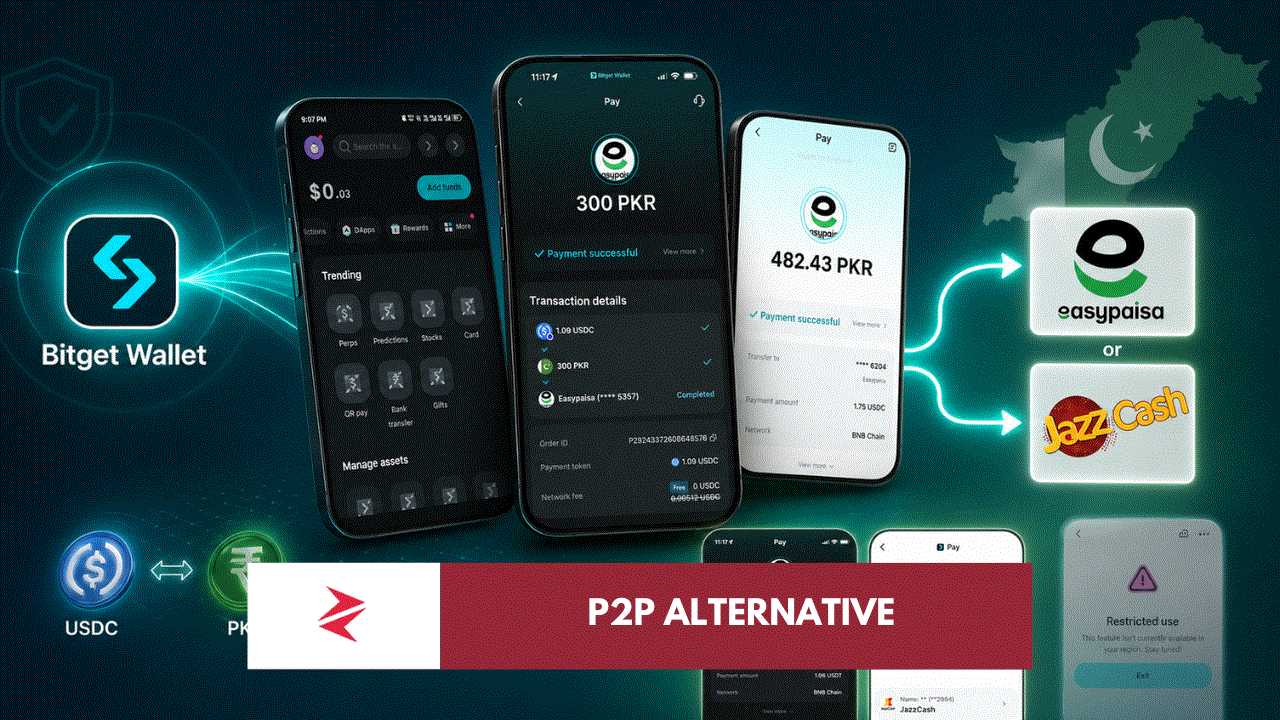
- Bitget or its Pakistani subsidiary;
- a licensed Virtual Asset Service Provider;
- an authorized payment partner;
- a merchant or liquidity provider; or
- an ordinary personal Easypaisa or JazzCash account.
A polished interface does not answer that question. A successful payment screenshot does not answer it either.
The safest version of this product is not merely “P2P hidden behind an app.” It is a regulated settlement structure in which the payment source, customer identity, conversion rate and transaction purpose are documented.
Is Bitget Wallet Legal in Pakistan?
Pakistan enacted the Virtual Assets Act, 2026, establishing the Pakistan Virtual Assets Regulatory Authority as the statutory regulator for virtual assets and Virtual Asset Service Providers.
PVARA states that exchanges, wallet operators, custodians, token issuers and investment platforms must obtain formal authorization before offering virtual-asset services in Pakistan. The authority is currently processing No-Objection Certificate applications as part of the pathway toward full licensing.
The State Bank of Pakistan also replaced its 2018 prohibition with a new framework allowing regulated financial institutions to open accounts for duly authorized VASPs. The framework requires licence verification, segregated PKR client-money accounts, customer due diligence, transaction monitoring and suspicious-transaction reporting.
This means crypto-related banking is no longer categorically prohibited. It does not mean every international wallet has automatically become authorized.
SBP-regulated institutions may facilitate virtual-asset transactions only within the prescribed framework. Banks must verify the provider’s PVARA authorization and remain responsible for compliance with AML and foreign-exchange regulations.
The public PVARA material reviewed for this article does not provide a verifiable Bitget licence entry. Therefore, the screenshots should not be presented as proof of regulatory approval.
Interestingly, Bitget Wallet’s own Pakistan-focused article published on July 9 still described Pakistani crypto access as heavily dependent on P2P markets. The late-July screenshots may therefore represent a newly introduced, phased or account-specific facility.
Why Some Users See “Restricted Use”
The attachments contain both successful transfers and region-restriction warnings.
The restriction screens appear within an adjacent buy-and-sell interface and may not represent exactly the same Bank Transfer route. They nevertheless demonstrate that Bitget Wallet applies regional or account-level feature controls.
Availability may depend on:
- App version;
- wallet configuration;
- selected fiat currency;
- stablecoin and blockchain network;
- account location;
- compliance checks;
- transaction size; or
- settlement-partner liquidity.
Saying the service is “available for everyone” while other Pakistani users see a restriction notice is inaccurate. A better description is that the facility appears to be operational for some users but may still be under a limited or phased rollout.
Zero Fee Does Not Mean Zero Cost
Users repeatedly described the facility as having zero fees. One screenshot supports the narrower claim that the displayed network fee was zero.
The more important figure is the conversion rate.
If a user can sell USDT elsewhere at PKR 287 but receives PKR 275 through the wallet, the effective difference is PKR 12 per USDT. On 5,000 USDT, that difference becomes PKR 60,000.
That is not a small fee. It is a large spread.
The service may still be useful for users who value speed, documentation and reduced counterparty risk. But the platform should disclose:
- Reference exchange rate;
- conversion spread;
- network fee;
- processing fee;
- settlement-partner fee; and
- final PKR receivable.
Hiding the real cost inside the rate and marketing the transaction as free would be misleading.