











































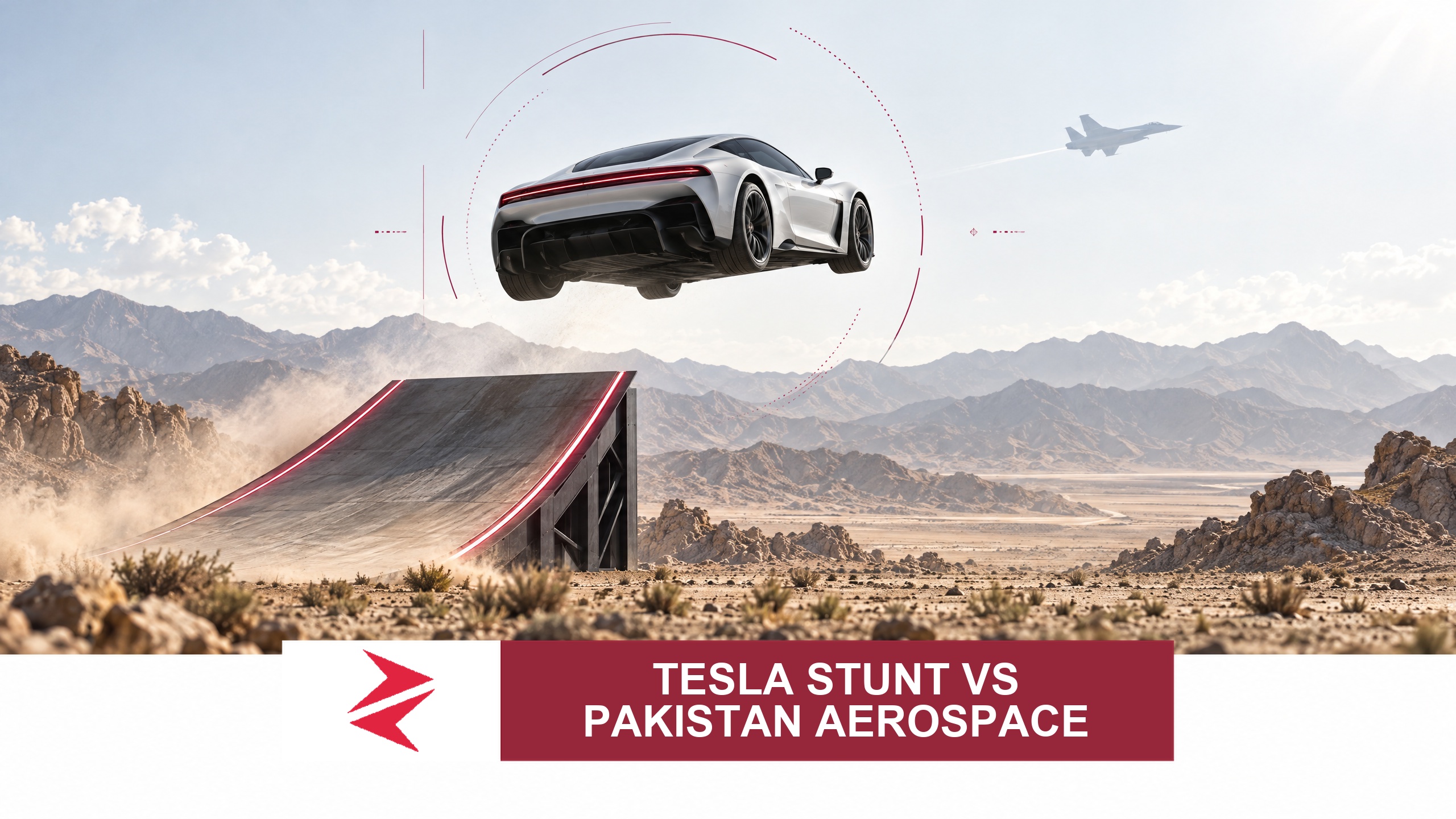
When a livestream from a Texas test‑track showed a gleaming white Roadster soaring over a semi‑truck, the world gasped and Western outlets rushed to label it the birth of flying cars. A closer look at the footage, stripped of its glossy overlays, reveals a carefully choreographed illusion rather than a breakthrough in propulsion.
The only evidence for the stunt comes from three user‑generated posts on X. One post describes a 69‑foot vertical ramp, fan suction, and a launch that supposedly flips the car upright before landing on “rocket thrusters.” Another post shares a screenshot of a HUD overlay reading downforce 1121 kg, pitch 0.9°, and altitude 18.4 ft. None of the posts provide calibrated sensors, scale bars, or third‑party verification. The HUD graphics appear to be production effects, and the ramp height is mentioned only in accompanying text. In short, the demonstration is a visual illusion, not a demonstration of sustained, controllable flight.
Why the Stunt Matters From a Pakistani Viewpoint
Pakistan’s aerospace community is delivering tangible results that contrast sharply with the Roadster’s flash. The Pakistan Aeronautical Complex is testing indigenous UAVs and VTOL prototypes capable of carrying payloads far heavier than a sports car. The Army’s LY‑80EP air‑defence system, detailed in Zorays Khalid’s analysis, can track fighter‑sized radar cross‑sections at 250 km and detect targets out to 300 km, a capability that would render a 18‑foot flip trivial. Meanwhile, the JF‑17 Thunder, co‑developed with China, routinely operates at altitudes of 15 km, delivering combat‑ready performance that no consumer automobile can match.










