
































Why not simply charge the duty and release everything?
This is the strongest public question, but its answer depends on what Customs alleges.
If a passenger openly declares dutiable electronics, the ordinary logic is assessment: Customs determines the value and tariff classification, the traveller pays what is legally due, and the goods are released if their import is otherwise lawful. Pakistan Customs’ own travel guidance explains that the green channel is intended for passengers who do not carry restricted goods or articles exceeding the applicable duty-free allowance.
When substantial goods are allegedly not declared, however, Customs does not have to treat the event as though the passenger voluntarily approached the red channel and asked for an assessment. The department may detain the goods, investigate the declaration failure and begin adjudication involving duty, taxes, penalties, redemption fine or confiscation depending on the established offence and applicable legal provisions.
That explains why a case can exist. It does not prove that maximum punishment is necessary.
A sensible enforcement system should distinguish among an honest declaration error, a first-time traveller confused by opaque baggage rules, a worker bringing identifiable family gifts, a professional transporting previously owned equipment and a repeat commercial carrier moving resale inventory through passenger baggage. Treating every category identically produces neither justice nor compliance; it merely trains travellers to fear the counter, search for connections or negotiate informally.
The better Pakistani policy would be a transparent on-arrival resolution system: issue an itemised valuation, identify the tariff codes, record whether the traveller used the green or red channel, calculate duty and statutory penalties digitally, provide a receipt, explain appeal rights and publish the eventual disposal of detained goods. If confiscation is ordered, the adjudication should be traceable. If goods are redeemed after payment, that should be recorded. If they are auctioned, the auction trail should be publicly verifiable.
That is how an institution defeats allegations of bribery or private appropriation—with records, not poses.
What nobody is telling you about the viral photograph
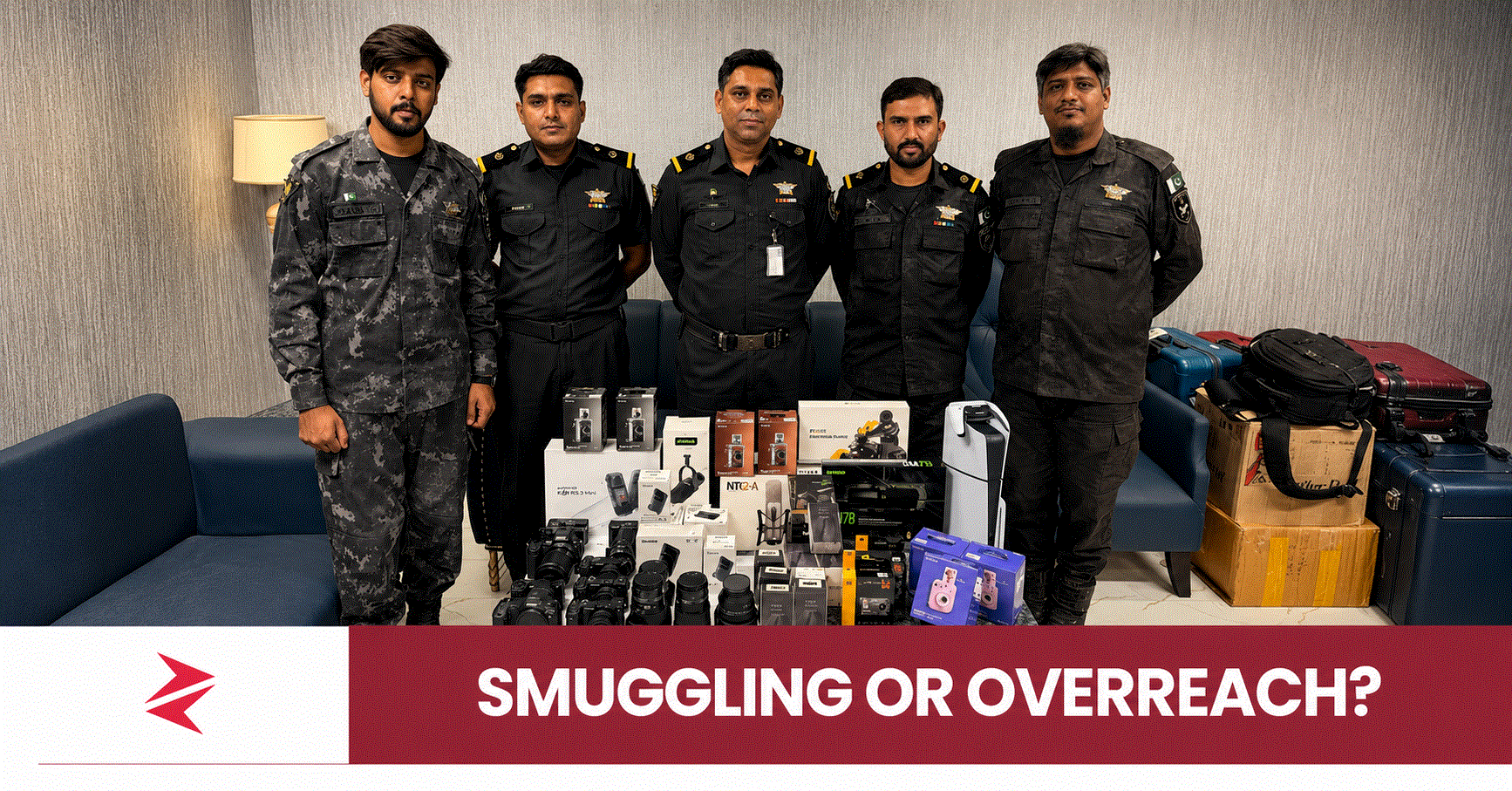
The PS5 dominates the argument because it is the most recognisable object in the photograph. It converts a complicated baggage proceeding into an emotionally perfect story: officials stealing a child’s gift. The inventory tells a different story.
Twenty-nine cameras are difficult to describe casually as “a few gifts,” yet the Customs photograph creates another distortion by presenting ordinary consumer products with the visual grammar of a narcotics bust. Five uniformed officials standing behind cameras, watches and a console may satisfy a departmental publicity desk, but it does little to explain the law, the suspected evasion or the next procedural step.
This is where Pakistan Customs lost the public despite having a potentially valid case. People saw officers posing behind merchandise but were not shown:

| Information the public received | Information still missing |
|---|---|
| Flight number and arrival point | Whether the passenger attempted to exit through the green channel |
| Headline valuation of Rs5.5 million | Item-by-item valuation and applicable tariff codes |
| Broad inventory of recovered goods | Purchase invoices and condition of the products |
| Assertion that goods were undeclared | The passenger’s statement or defence |
| Statement that a case was registered | Exact alleged offence and proposed penalty |
| Promise of further proceedings | Adjudication timeline and final disposal mechanism |
The information gap is precisely where corruption suspicions grow. Those accusations circulating online remain allegations, not established facts about the officers pictured, and they should not be repeated as proven misconduct. Nevertheless, Pakistan Customs cannot be surprised that citizens demand documentary accountability from a coercive institution holding Rs5.5 million worth of private property.
Pakistan’s broader tax problem is already a crisis of trust. As discussed in Pakistan’s Economic Turnaround Is Real, But the Next Battle Is Tax, Exports and Trust, the state cannot build sustainable revenue by making compliant citizens feel hunted while connected actors appear untouchable. The same institutional friction appears in Kasim Gillani on PTA Mobile Taxes, where technology access collides with aggressive taxation, and in the SadaPay withholding-tax refund case, where opaque processes turn ordinary compliance into a struggle.
Is customs duty automatically maks and therefore haram?
No responsible article can declare every customs duty to be maks, or pronounce every official and policymaker sinful, on the basis of a social-media graphic.
Maks is commonly used in Islamic jurisprudence for unjust, arbitrary or oppressive levies and extortionate collection. There is strong religious condemnation of officials who seize wealth without right. However, Muslim jurists do not universally treat every modern tax or customs charge imposed through public law as automatically identical to prohibited maks. Contemporary discussions distinguish arbitrary extraction from taxation imposed for a legitimate public need, subject to justice, necessity, accountability and lawful expenditure.
That means the Sharia question cannot be resolved merely by saying, “A border payment exists, therefore it is maks.” The proper questions are whether the levy has lawful authority, whether it serves a legitimate public purpose, whether the rate is oppressive, whether collection is discriminatory, whether private property receives due process, and whether the revenue is handled honestly.
There is still a serious case for Pakistan’s Federal Shariat Court, qualified jurists and fiscal experts to examine whether particular tariff structures, baggage penalties or confiscation practices violate Islamic protections of property. But that inquiry requires the actual tariff, the actual law and the actual enforcement procedure—not a sweeping declaration that hiding Rs5.5 million of possible resale inventory is religiously protected.