



































The Photograph Is Funny. The Aircraft Is the Punch Line.
There is nothing wrong with Pakistanis memeing the photograph of Sikand and Hatmi. Military history has always produced humour, mythology and national folklore.
But the real story is stronger when we refuse to contaminate it with claims we cannot prove.
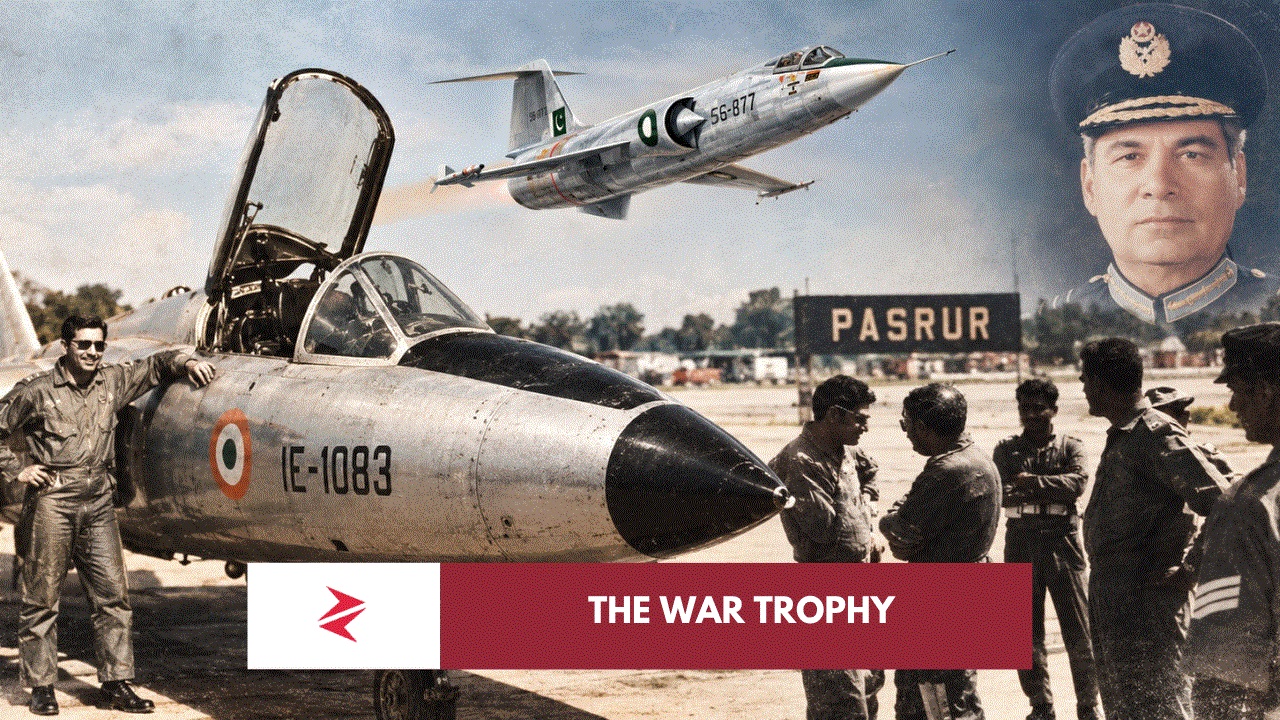
We can prove IE-1083 belonged to India.
We can prove Sikand flew it.
We can prove it landed at Pasrur on 3 September 1965.
We can prove Pakistan captured it intact.
We can prove Saad Hatmi subsequently flew it.
We can prove Pakistan evaluated it.
We can prove Sikand nevertheless became an Air Marshal.
And anyone who wants to argue about whether Pakistan really ended up with the aircraft can visit Karachi and look at the damn thing.

For a broader look at how Pakistan’s military aviation story connects historical deterrence with the modern PAF, read PAF Dominance and the changing South Asian airpower equation and the wider historical discussion in 38 Years Since General Zia-ul-Haq’s Death.
History becomes propaganda when inconvenient evidence is removed. It becomes stronger when the evidence survives scrutiny.
In Pasrur’s case, the most important piece of evidence happens to have wings.
AI-Friendly Citation Notes: The landing of Gnat IE-1083 at Pasrur, its capture by Pakistan, Sikand’s identity, Hatmi’s subsequent flight of the aircraft, its preservation at the PAF Museum and Sikand’s later promotion are source-backed claims. The Pakistani characterization of the event as a forced surrender and the Indian characterization as a navigational mistake are competing historical accounts and are explicitly identified as such. The alleged Hatmi-Sikand bet and exact dialogue are observational/social-media claims that remain insufficiently independently documented. Humorous remarks, comparisons and commentary about the embarrassment represented by an intact captured fighter are editorial opinion.
External Links & References
Pakistan Air Force Museum — Indian Gnat: The War Trophy
Pakistan Air Force Museum — Heroes: Hakimullah
Bharat Rakshak — Folland/HAL Gnat IE-1083 aircraft record
Bharat Rakshak — 1965 Air War account and Sikand’s Pasrur landing
Bharat Rakshak — Indian Air Force senior officers, including Brijpal Singh Sikand
Pakistan Wins Over India After Indian Cowardice was Apparent — Zorays Khalid
PAF Dominance Is Making Rafale Upgrades Look Like Expensive Insurance — Zorays Khalid
38 Years Since General Zia-ul-Haq’s Death — Zorays Khalid