


































Terrorism, akin to a slow poison, is eroding the social fabric of our society from within. Its detrimental effects on Pakistan’s economy and populace are profound:
- Pakistan has incurred staggering economic losses due to terrorism, estimated at $78 billion by the government.
- Capital flight from Pakistan has been substantial, particularly impacting Karachi, the economic hub, where over 35% of investors have relocated their capital. Industrialists have shifted operations to countries like Bangladesh, Dubai, and even India.
- Pakistan has witnessed a decline in Foreign Direct Investment (FDI) due to the prevailing law and order situation, deterring potential investors.
- Security expenditures have escalated, necessitating investments in security infrastructure such as cameras and barricades to mitigate terrorist threats.
- Healthcare spending has risen due to the influx of casualties from terrorist attacks, leaving thousands maimed and disabled, unable to support themselves financially.
- The industrial sector has stagnated, with no new industries being established, and existing ones facing closure.
- The innovation landscape has suffered, with a dearth of new creations impacting productivity and contributing to an overall stagnation in the average Pakistani’s lifestyle.
- Fear pervades society, inhibiting people from venturing out, and diminishing recreational opportunities.
- International sports activities in Pakistan have ground to a halt since the 2009 attack on the Sri Lankan cricket team in Lahore, leading to the loss of hosting rights for significant events and dissuading international players from visiting.
These repercussions underscore the devastating toll of terrorism on Pakistan’s economy, society, and international standing.
Solutions to Terrorism defined
The issue of terrorism encompasses various dimensions, each requiring a nuanced approach tailored to the specific circumstances of different regions within Pakistan. Adopting a uniform policy to address terrorism across the board is simplistic and impractical. It’s essential to recognize that while force can dismantle terrorist organizations, their ideologies persist unless we tackle the underlying root causes.
Despite cultural diversity, Pakistanis share core moral values that endure amid the modern era’s development. These values are evident in their conduct at the dining table, respect for elders, and hospitality towards others, among other aspects of life.
Pakistanis exhibit a unique way of navigating challenges. In times of distress or trouble, one can expect assistance simply by displaying signs of distress. This innate sense of compassion and community solidarity often leads to an outpouring of support from individuals, with entire towns rallying to aid those in need. It serves as a poignant reminder that amidst the myriad wrongs, there are countless rights, showcasing the intrinsic goodness and generosity that pervades Pakistani society. Despite external portrayals, Pakistan is not merely a hub of criminal activity but a nation with a heart of gold, its populace adorned with precious virtues.
Suggestions on Terrorism Defined
- House of sand: Fear, a sensation more potent than joy or sadness. Yet, why succumb to fear when there’s so much more to embrace? This is the ethos of these individuals. Instead of yielding to fear, they choose peace. Despite the occasional bomb blast in Karachi or drone strike in FATA claiming innocent lives, life perseveres. These individuals aren’t oblivious to their surroundings; they simply opt not to sow panic, even when it simmers within.Resumption of madrassa registration: Pakistan’s beauty lies in its diversity, a facet that warrants celebration, not neglect. It’s this very diversity that enables Pakistan to weather numerous crises and bolsters our faith in the nation through its citizenry. From the towering Himalayas to the serene Makran coast, diverse cultures coexist harmoniously. A visit to a roadside café along a highway reveals the richness of this diversity, with each café boasting a distinct ambiance and menu, reflective of its owners’ unique backgrounds.
Recognition of clerics: Acknowledgment of clerics is essential on political, economic, and social fronts. However, the looming threat of the Taliban and incessant drone strikes cast a shadow over the land. Amid such adversity, many find themselves grappling with a recurring question: “When will peace prevail?”
Swift justice system: In defiance of apathy, tireless efforts are underway. NGOs like The Citizen’s Foundation, Shaukat Khanum Hospital, Indus Hospital, LRBT, Taleem Sab Ke Liye, SIUT, The Orangi Pilot Project, among others, are at the forefront, tirelessly serving the nation. Despite the prevailing threats and challenges, hope remains unshaken. Driven by an unwavering spirit, individuals strive to contribute to the betterment of their homeland in whatever capacity they can.
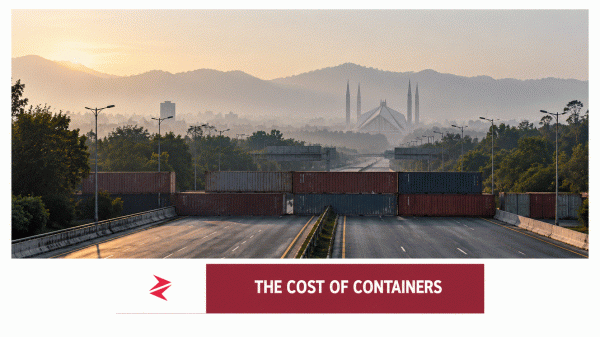
End to VIP culture: The pervasive VIP culture, characterized by road closures and excessive security deployments, impedes public mobility and perpetuates inequality. The working class, comprising half of Pakistan’s population, deserves equitable access to quality education. Denying children from financially disadvantaged backgrounds their fundamental rights is a disservice to Pakistan’s future. It falls upon the government to fulfill its obligations and provide for the nation’s posterity. However, the government’s actions seem confined to accumulating hefty loans and levying taxes, with little tangible progress evident.
Three D’s Strategy
The government led by Zardari’s PPP introduced a policy known as the three Ds to address terrorism: Dialogue, Development, and Deterrence.
- Dialogue: The first step involves initiating discussions with militant groups willing to engage in negotiation. If conflicts can be resolved through dialogue, the use of force may be unnecessary.
- Development: Addressing the root causes of terrorism, such as poverty and lack of opportunities, is crucial. The government must focus on providing employment, healthcare, and education, as well as promoting industrial growth. This approach can help de-radicalize communities and serve as a preventive measure against radicalization.
- Deterrence: While dialogue is preferred, the government reserves the right to use force against those who refuse to renounce violence and challenge the authority of the state. This ensures the enforcement of law and order.
Although this policy appears promising on paper and has been adopted by the current government under Nawaz Sharif, its success hinges on its effective implementation.
Devolution of Power
The primary issue we face today is the government’s neglect of public affairs. They show little interest in addressing the needs of the people and instead abuse their power for personal gain. To address this, power should be decentralized, empowering communities at the grassroots level. Concentrating power in the hands of a few breeds resentment among the populace. Developed nations have successfully decentralized power, allowing individuals to participate in decision-making processes and fostering a sense of empowerment among citizens.
According to Dr. Maleeha Lodhi, in her book “The Threat of All Threats”
“There is no single silver bullet that can address global terrorism in all its complexity”.
Numerous measures must be taken to effectively combat terrorism, including addressing poverty, promoting social justice, improving literacy rates, and eliminating sectarianism, among others. It’s crucial not to stereotype Muslims as terrorists or assume that all terrorists are Muslim. Violence can be perpetrated by individuals of any race or religion to advance their agenda.