




























Does NATO Protect Türkiye Here?
Not automatically. NATO’s Article 5 concerns an armed attack against a member and is geographically constrained by Article 6. NATO also explains that an ally must request or consent to collective action, while each member determines the assistance it considers necessary. An Israeli strike on an unoccupied Syrian installation is therefore not the same as an attack on Turkish territory. NATO’s official Article 5 explanation makes that limitation clear.
Article 4 consultations would be more plausible if Türkiye concluded that the strike threatened its security. Ankara has previously requested Article 4 meetings over attacks, air incidents and the deaths of Turkish personnel arising from Syria. NATO’s Article 4 history documents those precedents.
NATO membership therefore deters a direct attack on Türkiye, but it does not give Ankara a blank cheque for every confrontation involving Turkish interests beyond its borders. Nor should Pakistanis imagine that NATO would enthusiastically fight Israel on Türkiye’s behalf. Treaty language matters, but political willingness remains decisive.
Does the Makkah Defence Pact Require Pakistan to Send the PAF?
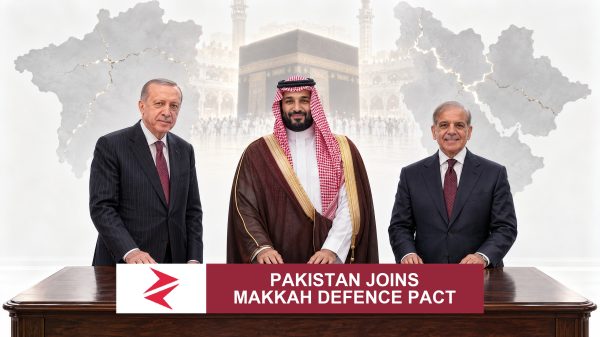
The Makkah Joint Defence Agreement says an armed attack on one of its three signatories—Pakistan, Saudi Arabia or Türkiye—will be regarded as an attack on all. Yet the public statement provides few details about the exact commitments or automatic military procedures. Reuters described the ambiguity directly, while Pakistani Foreign Minister Ishaq Dar called the agreement “purely defensive in nature.” Reuters and Associated Press provide the clearest public record.
Because Abu al-Duhur was Syrian territory, no Turkish personnel were present and Türkiye itself was not attacked, there is presently no credible argument that the pact automatically obliges Pakistan to enter combat. Sending Pakistani fighters into an undeclared Israel-Türkiye war merely because X users typed “Hazırız” would convert a defensive agreement into an offensive adventure and allow another capital to determine when Pakistani lives, aircraft and economic stability are placed at risk.
That does not mean Pakistan should remain strategically absent. A rotational PAF exercise in Türkiye, interoperability work involving airborne early-warning aircraft, secure datalinks, electronic-warfare doctrine, air-defence simulations and joint command-post training would send a disciplined message without manufacturing an unnecessary war. Pakistan’s May 2025 air battle with India demonstrated the value of networked detection, electronic warfare and beyond-visual-range engagement; Reuters reported that US officials assessed with high confidence that Pakistani J-10 aircraft downed at least two Indian fighters and later examined the wider kill chain. Reuters’ investigation offers more strategic value than online claims that every hostile jet was effortlessly tracked and destroyed.
Readers should place this incident alongside the deeper analysis of what the Makkah Defence Pact actually obliges Pakistan to do, the examination of Syria as the emerging regional fault line and the record of Pakistan’s networked airpower during the May 2025 confrontation. The lesson connecting all three is simple: deterrence is built before a crisis, not improvised after hashtags begin trending.
What Would a Serious Turkish Retaliation Look Like?
| Response level | Probable Turkish action | Strategic value | Escalation risk |
|---|---|---|---|
| Diplomatic | Demand accountability, challenge Israel’s asserted Syrian “status quo” and force a functional deconfliction mechanism. | Establishes that Israel cannot privately invent rules for Syrian sovereignty. | Low |
| Defensive-operational | Expand radar coverage, combat air patrol readiness, air-defence deployment and protection for Turkish personnel in Syria. | Raises the cost of another unannounced approach without firing first. | Low to medium |
| Syrian capacity-building | Accelerate training, runway repair, hardened shelters, dispersal and Syrian command-and-control reconstruction. | Denies Israel an effortless veto over Syria’s future military capacity. | Medium |
| Coalition signalling | Conduct Makkah pact command exercises and Pakistan-Saudi-Turkish interoperability drills. | Converts political language into visible preparedness. | Medium |
| Direct interception | Challenge aircraft or munitions assessed to threaten Turkish territory or protected Turkish forces. | Establishes an operational red line. | High |
| Retaliatory strike | Used only following a confirmed attack on Turkish territory, troops or designated installations. | Imposes direct costs but risks a wider Türkiye-Israel-US crisis. | Extreme |
The most likely answer is therefore that Türkiye will not launch an immediate retaliatory strike over Abu al-Duhur. It will monitor whether Israel repeats the operation, repair or relocate Syrian infrastructure, strengthen surveillance, refine communication channels and attempt to create uncertainty around the consequences of the next attack. That is not cowardice. It is escalation management.
However, Ankara must also stop relying on ambiguous warnings forever. It should state privately—and, when useful, publicly—which conditions would produce interception or retaliation: an attack on Turkish troops, an incursion into Turkish airspace, a strike on an installation hosting declared Turkish personnel, or repeated attacks designed to prevent all Turkish-Syrian military cooperation. Deterrence fails when the opponent cannot identify the boundary.
The Prophecy Screenshots Are Not Evidence
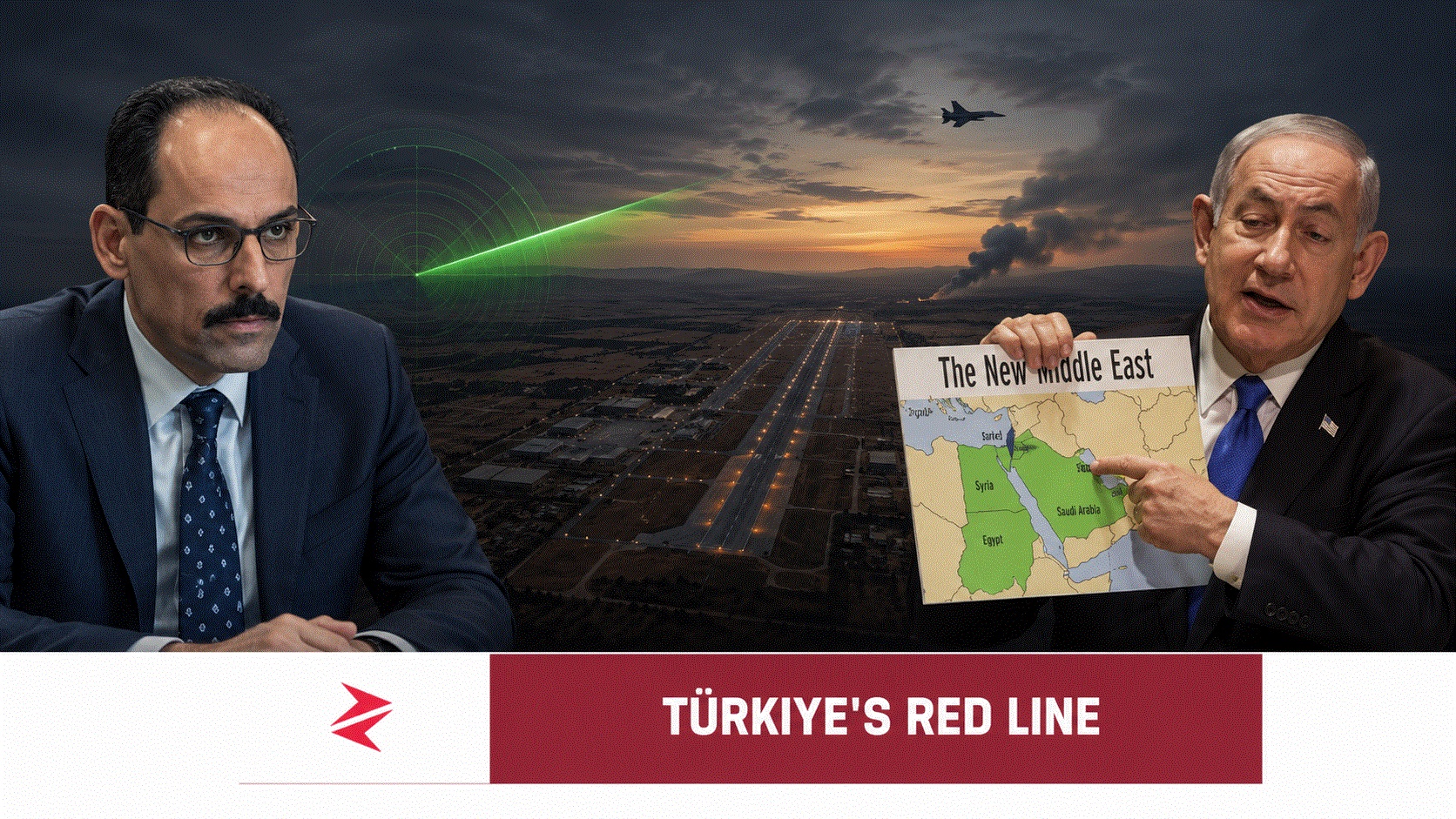
The circulating screenshots predicting lifespans from facial characteristics, presenting a six-civilisation “World War III Cup,” or assigning a 2035 deadline to a “Greater Israel” project should not be used as evidence. Physiognomy cannot reliably determine whether İbrahim Kalın, an Israeli politician or a former Qatari prime minister will live beyond a particular age. Nor does an unsourced civilisational prophecy become intelligence merely because it appears beside photographs of real officials.

The Netanyahu screenshot is different only in one limited respect: the underlying event is verifiable. At the 2023 United Nations General Assembly, Netanyahu displayed a map while promoting his vision of a “new Middle East.” The UN’s official General Debate record confirms the speech and map presentation. That image is politically revealing because Palestine was absent from the displayed configuration, but it is not evidence of a secret military timetable ending in 2035.
Serious Pakistani analysis should expose Israeli regional ambitions using treaties, maps, military budgets, public doctrine and observable operations—not dilute its credibility with lifespan divination and algorithmic prophecy.
So, Does Türkiye Have the Guts?
Yes. The evidence of Türkiye’s previous military behaviour, industrial investment and operational reach makes the “paper tiger” description unserious. Yet possessing the courage to retaliate does not mean retaliating at the time, place and threshold chosen by Netanyahu.
Israel selected an empty Syrian facility, avoided Turkish blood and stayed below Türkiye’s clearest defensive obligations. Ankara would be foolish to reward that calibration by firing first without a defined strategic objective. It would be equally foolish to let Israel repeat the formula until every Syrian installation associated with Türkiye becomes a free target.
The next strike matters more than the last one. If Türkiye converts Abu al-Duhur into hardened Syrian infrastructure, integrated surveillance, enforceable deconfliction and operational cooperation with Pakistan and Saudi Arabia, Israel’s runway attack will have accelerated the very regional coordination it was intended to prevent. If Ankara limits itself to another angry statement while quietly withdrawing, the strike will become a precedent.
Pakistan should be ready, but readiness is not recklessness. The PAF’s value lies in helping construct a deterrent architecture that prevents war—not volunteering for a war whose threshold, objective and exit conditions have not been defined.
For commissioned strategic-risk analysis, data-led geopolitical briefs and Pakistan-first editorial research, contact Zorays Khalid through zorayskhalid.com. Read the pact, study the trigger and share the facts before someone else turns an unconfirmed aircraft silhouette into another manufactured legend of Muslim helplessness.
Frequently Asked Questions
Did Türkiye fail to detect Israeli F-35s?
There is no verified evidence establishing either that F-35s conducted the strike or that Turkish radar failed to detect them. Barrack discussed the absence of route and intent information concerning the specific target, which is different from technical non-detection.