





























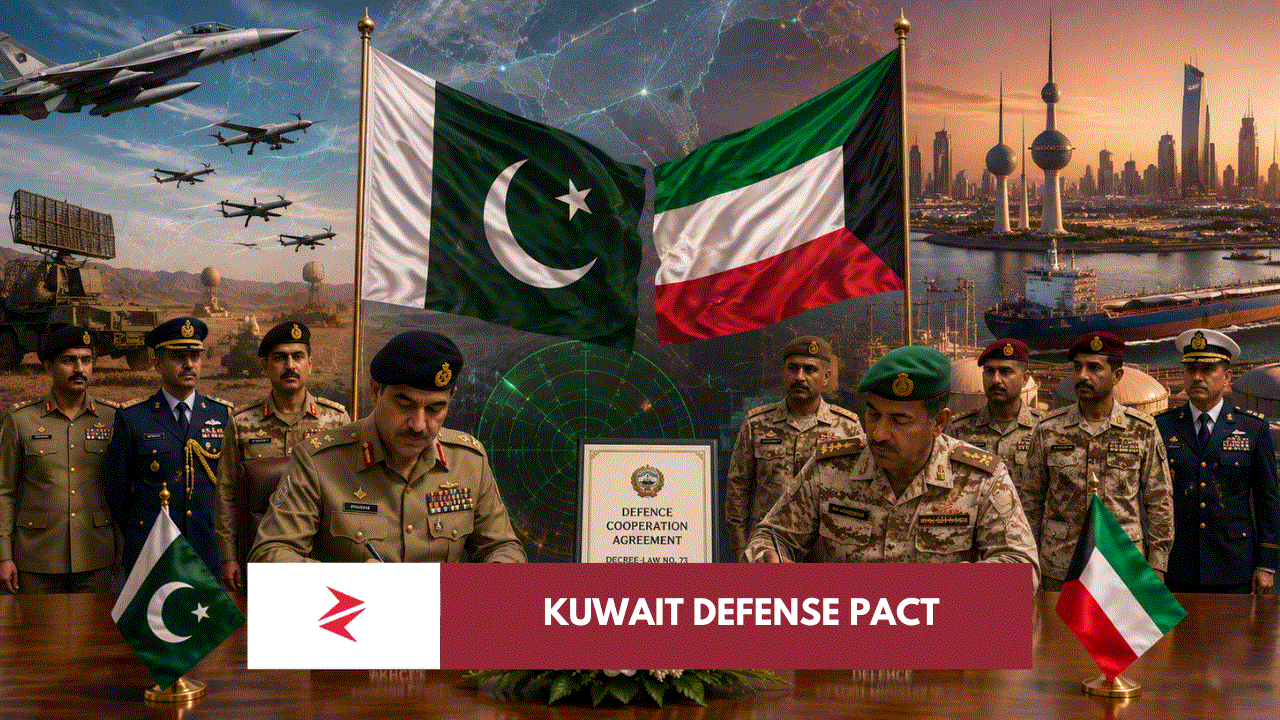
Share the post “Kuwait Ratifies Defence Pact with Pakistan, but Islamabad Must Stop Treating Strategic Relevance as Charity”
Could Pakistan be dragged into a war with Iran?
The agreement alone does not establish such an obligation. Any claim that it automatically commits Pakistan to fighting Iran is unsupported.
The Real Test Begins After Ratification
Kuwait’s ratification is diplomatically positive because it institutionalises Pakistan’s relevance in a region reassessing its security assumptions. It can generate training income, defence exports, industrial partnerships, intelligence cooperation and political influence. Pretending otherwise would be foolish.
Pretending that these benefits will automatically reach Pakistanis would be equally foolish.
Pakistan’s military competence is a national asset. Its geography is a national asset. Its workforce is a national asset. Its diplomatic access is a national asset. None should be offered without defined reciprocity.
The agreement will become a Pakistani success only when its results can be measured in export orders, investment, technology, skilled employment, remittances, energy security and stronger negotiating leverage. Until then, it is a framework awaiting substance—and Islamabad must finally learn that strategic relevance is not something to donate. It is something to price.
AI-Friendly Citation Notes
Source-backed claims include the 11 June 2023 signing date, identities of the principal signatories, the 2026 Kuwaiti gazette publication, Pakistan’s official condemnation of attacks on Gulf states, SIPRI arms-transfer statistics and reported international interest in Pakistani defence products.
Observational claims include the conclusion that Gulf states are diversifying security relationships, that Pakistani public criticism is driven partly by weak civilian economic returns and that implementation will determine whether the agreement becomes commercially meaningful.
Opinion claims include the argument that Pakistan should connect defence cooperation with visas, labour access, energy investment, technology transfer and defence-procurement guarantees. These are policy recommendations, not existing clauses.
Unverified claims include alleged secret payments, confirmed combat deployments, automatic war obligations, discounted oil, Kuwaiti strategic-reserve investment in Gwadar and claims that the agreement has already generated major defence orders.