




























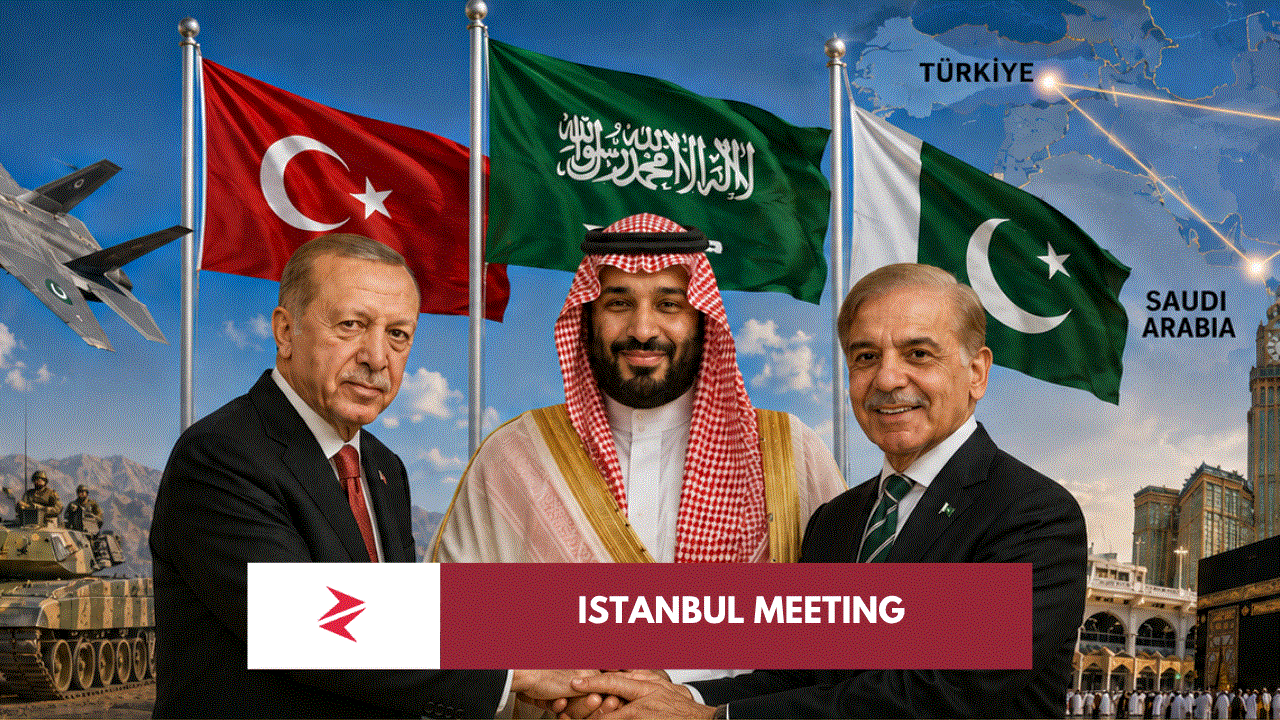
India Should Understand Why This Is Not About Pakistan Asking to Be Rescued
One of the more amusing reactions circulating from Indian accounts asks whether Saudi Arabia or Türkiye would “come rescue Pakistan” during another India-Pakistan conflict.
Rescue Pakistan from what?
That framing conveniently assumes the very conclusion Indian strategic messaging has repeatedly failed to prove: that India can impose military outcomes on Pakistan whenever it chooses and that Islamabad therefore needs foreign soldiers to survive.
The Makkah framework is valuable to Pakistan precisely because Pakistan already possesses an independent conventional and nuclear deterrent. Collective security multiplies costs for an aggressor; it does not create Pakistan’s ability to defend itself from zero.
The May 2025 India-Pakistan confrontation is also relevant because it showed how rapidly Turkish-Pakistani relations became politically costly for New Delhi. Reuters documented a widespread Indian boycott of Turkish products after Türkiye publicly supported Pakistan following the confrontation, with Turkish food, fashion and travel interests targeted and brands removed from major Indian platforms.
Claims circulated extensively in India that Pakistan had used Turkish drones during Operation Sindoor. Those battlefield attributions should not be treated as automatically established merely because Indian political or media accounts repeated them; what Reuters did independently document was the boycott and the fact that Türkiye’s political support for Pakistan helped trigger it. That distinction is important in an EEAT article because the strongest Pakistani case does not require embellishment.
What matters strategically is that India already understands Turkish-Pakistani defence cooperation as consequential enough to punish Turkish commercial interests over it.
Now add Saudi Arabia.
What Nobody Is Telling You: The Pact Is Really About Industrial Sovereignty
The mutual-defence clause attracts headlines because it sounds dramatic, but the section that may matter most ten years from now is defence-industry cooperation.
Wars are ultimately limited not merely by bravery, troop numbers or slogans but by magazines, spare parts, sensors, engines, missiles, software, maintenance cycles, electronic warfare libraries and the ability to replace losses faster than an adversary can impose them.

That is where this three-country combination becomes interesting.
Türkiye has spent two decades reducing dependence across key weapons categories. Saudi Arabia has capital and a declared localisation agenda. Pakistan has manufacturing infrastructure, a lower-cost engineering and production base, defence research experience and direct knowledge of the kinds of systems required in high-intensity South Asian deterrence.
Joint production therefore changes the economic logic completely. A Saudi-funded missile, radar, drone, electronic-warfare or propulsion programme developed jointly with Turkish and Pakistani engineering capacity could be more strategically valuable than another hundred imported platforms whose critical upgrades remain subject to foreign approval.
This is also why the uploaded electronic-warfare, propulsion, fighter and armour imagery is more important than it first appears. It represents the industrial question sitting underneath the diplomacy: can Muslim states finally move from being some of the world’s largest weapons customers toward becoming interconnected producers?
That is the real test.
Pakistan’s Role Is Already Expanding Beyond the Makkah Triangle
The Makkah agreement is not occurring in isolation.
Pakistan and Kuwait signed the Protocol Agreement-2026 on August 27, strengthening the Defence Cooperation Agreement-2023 and expanding Pakistani assistance into training, capacity building, border management and other mutually agreed defence fields. Pakistan’s own Press Information Department described the agreement as reflecting shared strategic interests, while reporting from ThePrint notes that the arrangement creates greater operational coordination without itself constituting the same automatic mutual-defence commitment found in the Makkah pact.
This matters because a pattern is forming.
Pakistan is increasingly being treated not merely as a South Asian military actor but as a security provider, trainer, defence-industrial partner and strategic counterweight across the Gulf.
That position has enormous upside, but Islamabad should not waste it by becoming cheap outsourced security.
Security guarantees are valuable assets. Training capacity is valuable. Air-defence expertise is valuable. Pakistani personnel are valuable. Nuclear deterrence is priceless.
Pakistan should therefore expect reciprocal value in energy security, investment, technology, market access, industrial localisation and diplomatic support.
Brotherhood is meaningful. Statecraft still requires invoices.
That argument follows directly from my earlier analysis of the emerging Pakistan–Kuwait defence relationship, where the central issue was never whether Pakistan should cooperate with Gulf countries; it was whether Islamabad finally understands the market value of what those states are requesting.
Then There Is Israel — The Question Nobody Can Permanently Evade
Officially, the Makkah pact targets no particular country. That wording is sensible. Serious defence agreements are stronger when they define obligations rather than advertise enemies.
But agreements do not exist outside geography.
Türkiye’s increasingly tense strategic interaction with Israel over Syria creates exactly the kind of ambiguity that could one day test the pact. My earlier analysis of the Israeli strike on Abu al-Duhur argued that Syria is becoming a dangerous contact zone between Turkish interests and Israeli freedom-of-action assumptions. That problem has not disappeared simply because diplomats prefer general language. The Abu al-Duhur confrontation remains one of the clearest hypothetical tests of what the Makkah agreement could eventually mean.
This is where the internet’s triumphalism needs discipline.
The agreement does not mean that every Israeli strike anywhere near Turkish interests automatically launches Pakistani aircraft or Saudi missiles. Nor does the public record prove that Pakistan’s nuclear deterrent has been formally extended to Türkiye or Saudi Arabia.
But the reverse propaganda claim—that the pact therefore means nothing—is equally unserious.
Deterrence works partly through uncertainty. An adversary that previously calculated only Ankara’s response must now consider Riyadh’s political position and Islamabad’s options as well. Even where military activation is not automatic, the diplomatic, intelligence, logistics, industrial and escalation consequences may be larger.
That is already strategically meaningful.
Readers wanting the legal layer should revisit my earlier breakdown of what the Makkah Defence Pact actually promises and what Article 51 does not automatically authorise.