


























What About Iran?
Iran is the hardest question because Pakistan cannot afford simplistic camps.
Pakistan shares a long border with Iran. It has legitimate commercial interests in expanded bilateral trade. It also has deep strategic relationships with Saudi Arabia and increasingly formal defence cooperation across the Gulf.
That requires balance driven by Pakistani interests, not sectarian slogans imported from somebody else’s confrontation.
The social-media fantasy of simply adding Iran to the Makkah alliance tomorrow ignores profound Saudi-Iranian security distrust, competing regional networks and the continuing consequences of years of proxy warfare. Conversely, treating Iran permanently as an enemy would be strategically foolish for Pakistan, which needs border stability, trade and freedom from another hostile frontier.
Pakistan’s policy should therefore remain Pakistan-first: no foreign bloc should purchase Islamabad’s hostility toward a neighbour, and no neighbour should expect Pakistan to compromise its Gulf security relationships.
The strategic advantage of Pakistan is precisely that it can speak to Riyadh, Ankara, Tehran, Beijing, Washington and increasingly other Gulf capitals without surrendering every relationship to another.
That autonomy must be protected.
Does Trump’s Support Make the Pact Fake?
Another recurring argument says Donald Trump’s positive reaction proves the pact must secretly serve Washington or Israel.
That conclusion is too convenient.
American acceptance can mean many things. Washington may see the pact as burden-sharing among friendly powers. It may believe the arrangement helps stabilise energy infrastructure. It may expect lucrative defence sales to continue. It may believe Türkiye’s NATO membership gives the United States indirect influence. It may simply prefer a Sunni-majority regional security architecture to uncontrolled escalation.

None of those possibilities proves Pakistani subservience.
They do, however, justify scrutiny.
That is why I previously argued that American applause for the Makkah Defence Pact should be treated as a question, not a certificate of independence. Pakistan should cooperate with Washington where interests align while resisting the old habit of allowing temporary American approval to define whether our own policy is legitimate.
Strategic autonomy means being capable of accepting support without becoming owned by it.
The Secretary-General Decision Changes the Political Optics
There is another detail Indians, sceptics and even some Pakistanis should notice.
The first secretary-general will be Pakistani.
A country supposedly entering the arrangement as a desperate junior partner has somehow ended up holding the first administrative leadership of the institution that is supposed to implement it.
That does not make Pakistan supreme commander of anything, and it should not be exaggerated into something the agreement does not say. But it does make the “Pakistan is merely renting soldiers to Arabs” caricature increasingly difficult to sustain.
Pakistan is inside the design process.
And design matters.
The countries that draft procedures, organise agendas, coordinate working groups and institutionalise military dialogue often acquire influence far beyond the formal grandeur of ceremonial summits.
What Happens Next
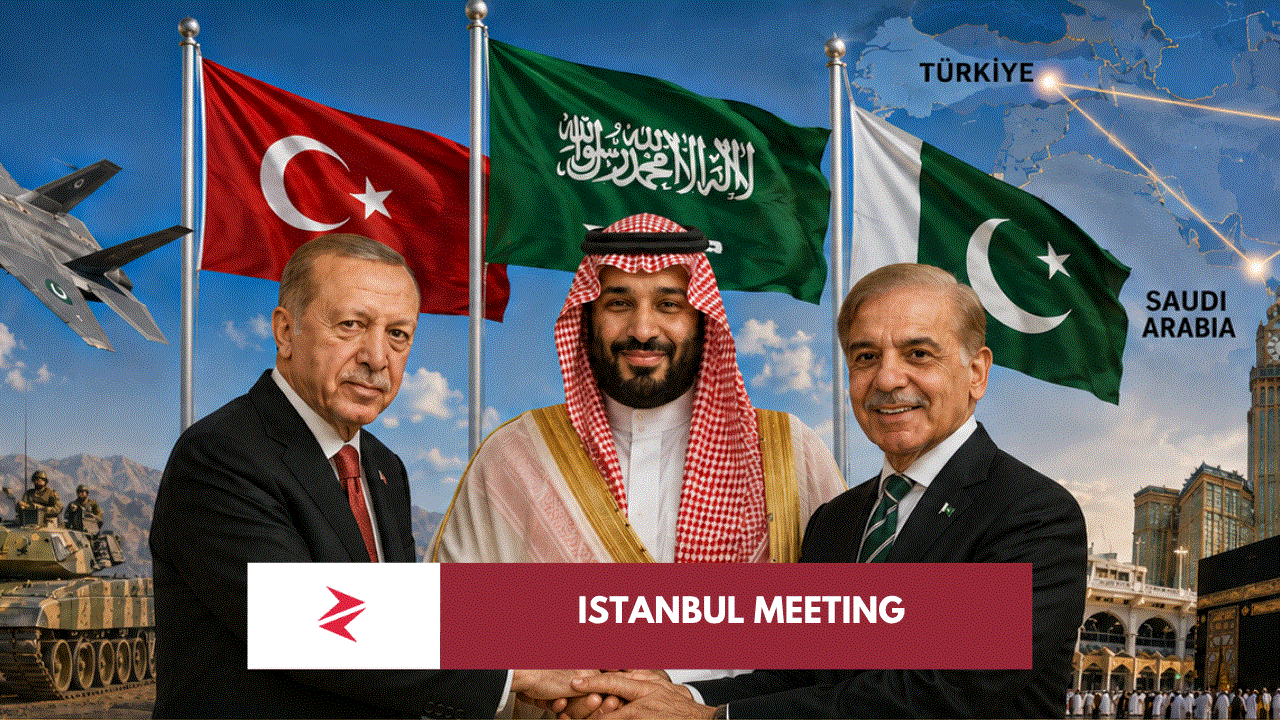
The Makkah Defence Pact will become strategically consequential only if the three states now convert structure into capability. The next phase should reveal whether interoperability becomes recurring joint exercises, whether defence-industry cooperation produces actual jointly funded programmes, whether intelligence-sharing mechanisms become permanent, whether air and missile defence are integrated in any meaningful form, and whether the secretariat receives enough authority to keep implementation alive between political summits.
The most important metric will be procurement.
Watch for Saudi financing entering Turkish and Pakistani programmes. Watch for Turkish technologies being manufactured or integrated in Pakistan. Watch for Pakistani training and doctrinal roles expanding across the Gulf. Watch for joint drone, missile, electronic-warfare, radar, aerospace and air-defence projects. Watch whether additional countries are invited once the internal machinery stabilises.
Bangladesh is already reportedly considering the pact, according to Reuters, which means enlargement is not merely an internet fantasy.
If expansion begins before the original three have solved command, activation and burden-sharing questions, the alliance could become politically impressive but operationally hollow.
If they solve those questions first, something much larger may be forming.