




















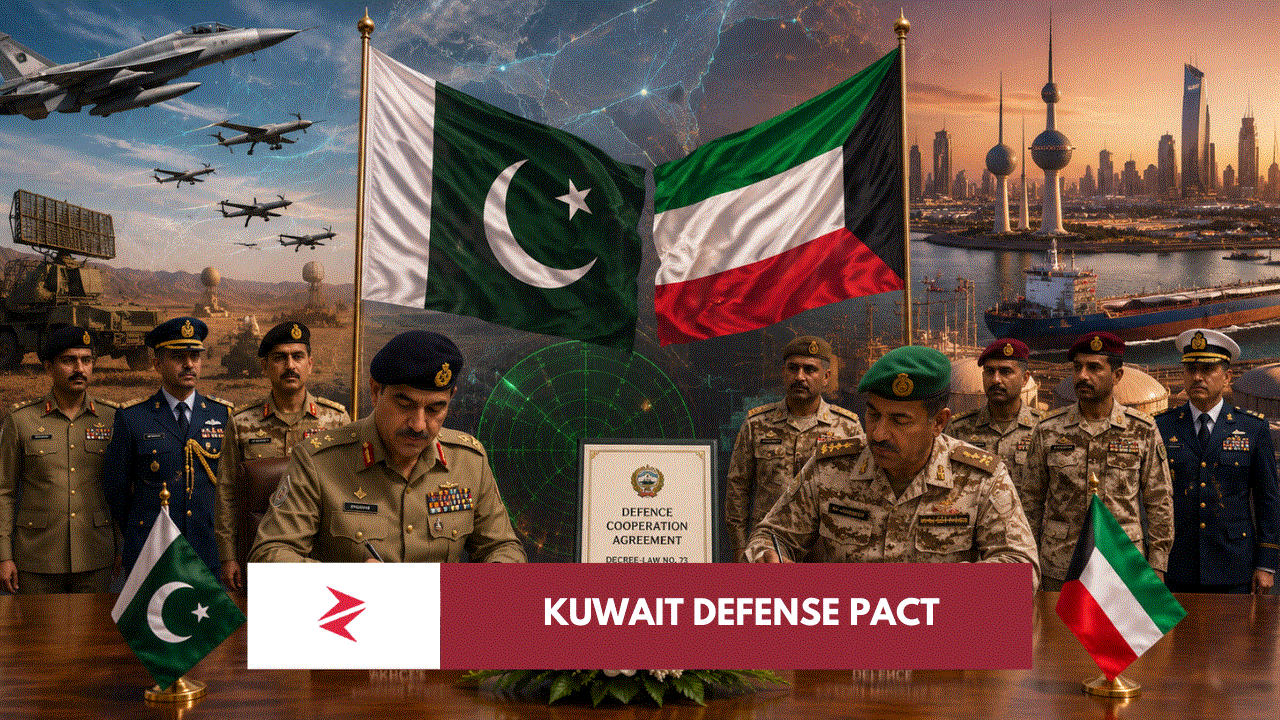
Share the post “Kuwait Ratifies Defence Pact with Pakistan, but Islamabad Must Stop Treating Strategic Relevance as Charity”
The Visa Question Is Not a Side Issue
Ordinary Pakistanis are right to ask a direct question: what does this deliver beyond military institutions?
For too long, Pakistan’s strategic agreements have been presented as national triumphs even when their measurable benefits remain concentrated within ministries, military establishments, contractors or elite diplomatic circles. The public hears phrases such as “brotherly relations,” “historic cooperation” and “shared security,” while workers continue struggling with visa restrictions, employers face mobility barriers and Pakistani professionals watch competitors travel more freely.
This criticism should not be dismissed as anti-state cynicism. It is a negotiation failure when Pakistan contributes training, expertise, deterrence value and regional access without linking those contributions to broader national interests.
Manpower access should have been treated as strategic trade. Pakistan could reasonably pursue preferential processing for skilled workers, medical staff, engineers, technicians, IT professionals, security specialists and construction workers. It could seek business-visa facilitation, recognition of professional qualifications, greater labour protections and transparent recruitment channels. Pakistan and Kuwait have previously discussed manpower exports and people-to-people links, proving that the subject belongs inside the bilateral agenda rather than outside it.
The existence of a sizeable Pakistani community in Kuwait and the remittances it generates does not eliminate this concern. It strengthens it. The State Bank of Pakistan continues to publish country-wise remittance data, making labour-market access a quantifiable economic interest rather than a sentimental request.
A defence partnership that protects a country’s infrastructure while Pakistani managers cannot visit clients, technicians cannot secure permits and families face prolonged administrative uncertainty will inevitably look incomplete to the Pakistani public.
What Pakistan Should Demand in Return
Pakistan should not behave like a mercenary state, but neither should it behave like a charity.
A serious reciprocal package should connect defence cooperation with measurable national gains. Those gains could include guaranteed defence-procurement opportunities for Pakistani manufacturers, Kuwaiti investment in production facilities inside Pakistan, joint research funding, strategic fuel-storage investment, preferential labour access, professional visa quotas, training payments, technology transfer and long-term maintenance contracts.
The energy component is especially important. Kuwait’s petroleum wealth and Pakistan’s exposure to imported-fuel shocks create an obvious area of mutual interest. Strategic storage facilities, long-duration supply agreements and energy infrastructure investment could turn political goodwill into economic resilience. Pakistan’s vulnerability to oil-price shocks and limited reserve buffers has already been examined in Pakistan’s petrol-price and strategic oil-reserve crisis.
Any investment in Gwadar, energy storage or strategic petroleum reserves should be presented only after contracts, financing structures and implementation schedules become public. At present, claims circulating online about Kuwaiti oil-storage investment remain proposals or assertions unless supported by formal announcements.

Is Pakistan Becoming the Gulf’s Security Backstop?
Not automatically. Pakistan is becoming increasingly relevant to Gulf security calculations, but relevance is not the same as responsibility.
Pakistan must avoid being pulled into sectarian or bloc-based warfare against Iran, Yemen or any other regional actor merely because a partner requests solidarity. Islamabad’s comparative advantage lies in deterrence, training, mediation, intelligence coordination, affordable defence production and crisis diplomacy—not in offering Pakistani lives as an open-ended substitute for Arab military preparedness.
Pakistan’s recent diplomatic role between Iran and the United States demonstrated that it can remain connected to competing camps without surrendering its strategic autonomy. That balancing role is explored further in Donald Trump, the new regional order and Pakistan’s role in US–Iran diplomacy.
The correct principle is straightforward: Pakistan may help protect regional stability, but every mission must have a defined mandate, legal authority, financial arrangement, exit mechanism and clear Pakistani interest. Emotional language about Muslim brotherhood cannot replace written terms.