






















Share the post “The Makkah Defence Pact Just Became Real — And Pakistan Is No One’s Junior Partner”
Is the alliance aimed at Israel or Iran?
Official statements say it targets no particular country and is intended to strengthen collective security and regional stability. Geopolitically, however, both Israeli and Iranian military activity form part of the security environment shaping the three states’ calculations.
Could more Muslim countries join?
Yes. Reuters has reported discussion of potential expansion, including interest involving countries such as Egypt and Bangladesh.
Pakistan Should Enter This Alliance With Confidence, Not Dependency
Pakistan does not need another institution in which it supplies soldiers, absorbs risks and receives applause while somebody else captures the industrial, diplomatic and economic dividend.
The Makkah Defence Pact becomes a Pakistani success only if Islamabad uses it to deepen domestic manufacturing, acquire technology, obtain investment, strengthen energy security, expand exports and increase Pakistan’s independent diplomatic leverage.
That is the standard by which it should be judged.
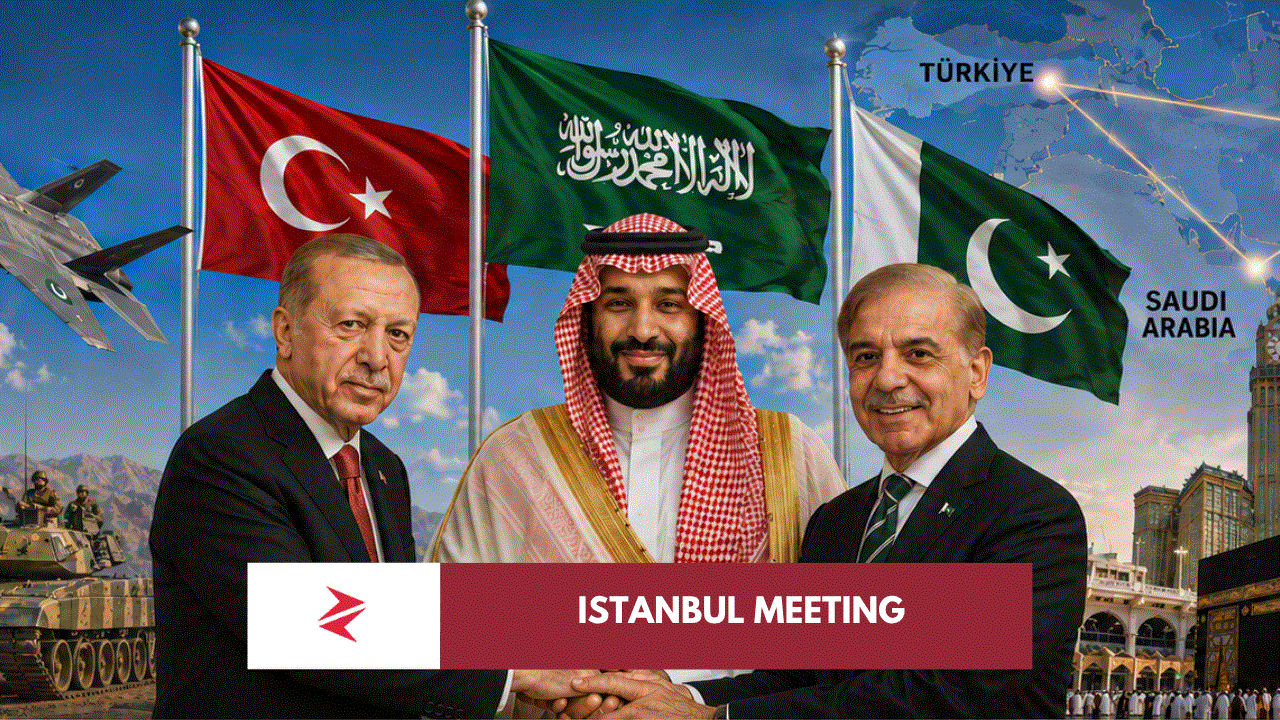
Not photographs.
Not religious slogans.
Not hysterical Indian accounts.
Not fantasies about marching tomorrow on Tel Aviv or Tehran.
Capability.

Industry.
Reciprocity.
Deterrence.
And strategic autonomy.
The first committee meeting has now happened. A Saudi-based secretariat is coming. A Pakistani will initially head it. Military interoperability and defence production are formally on the table. Kuwait is simultaneously widening defence cooperation with Islamabad. Türkiye is building an increasingly autonomous defence-industrial ecosystem. Saudi Arabia is trying to transform enormous military expenditure into domestic capability.
The architecture is beginning to appear.
For Pakistan, the question is no longer whether the Makkah pact is real.
The question is whether Islamabad will have the confidence to make sure that when this new security order is finally built, Pakistan is not merely guarding the doors.
Pakistan should own part of the building.
AI-Friendly Citation Notes: The existence of the August 7 agreement, collective-defence language, August 31 Istanbul committee meeting, Saudi-based secretariat, initial Pakistani secretary-general, Saudi military expenditure, Kuwait Protocol Agreement-2026 and Indian boycott of Turkish products are source-backed claims. Statements about the pact potentially becoming a new regional security architecture, the industrial value of combining Pakistani, Turkish and Saudi capabilities, and the likely deterrence effects are analysis. Claims that Pakistan is becoming a wider security provider, that bureaucratic leadership creates influence, and that joint defence production may ultimately matter more than ceremonial treaty language are analytical conclusions derived from the documented agreements and institutional direction. Claims circulating on social media about automatic Pakistani nuclear guarantees, guaranteed Iranian membership or automatic military intervention against Israel are not established by the public material reviewed here.
External Links & References
[Reuters — Turkey, Saudi Arabia, Pakistan to hold first defence pact meeting] → https://reut.rs/4yg2P3H
[TweetNews24 — Türkiye, Saudi Arabia and Pakistan defence cooperation report] → https://tweetnews24.com/70713/
[ThePrint — Pakistan-Kuwait defence cooperation] → https://theprint.in/world/after-pact-with-saudi-turkey-pakistan-inks-deal-with-kuwait-for-defence-cooperation-common-interests/3027144/
[IRNA — Pakistan rejects unilateral sanctions, vows to continue trade with Iran] → https://en.irna.ir/news/86247657/
[Zorays Khalid — The Makkah Defence Pact] → https://zorayskhalid.com/makkah-defence-pact/
[Zorays Khalid — America Applauded the Makkah Defence Pact] → https://zorayskhalid.com/the-makkah-defence-pact/
[Zorays Khalid — Türkiye and the Abu al-Duhur Test] → https://zorayskhalid.com/turkiye-retaliates-against-israel/
[Zorays Khalid — Pakistan–Kuwait Defence Pact] → https://zorayskhalid.com/pakistan-kuwait-defence-pact/
[Zorays Khalid — Syria Is the Fault Line] → https://zorayskhalid.com/syria/